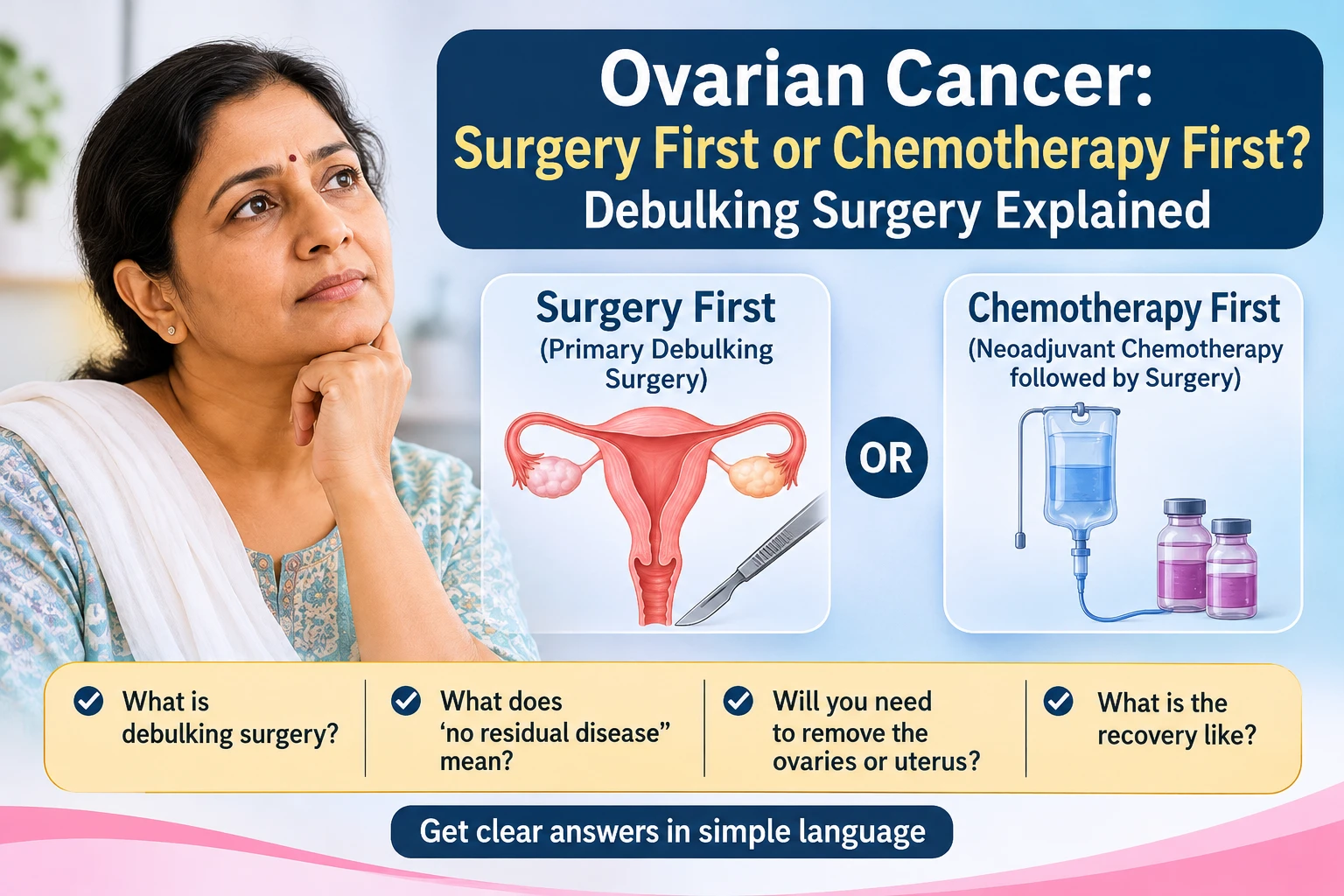
Surgery first or chemotherapy first: both routes aim to remove all visible cancer safely.
When ovarian cancer has spread beyond the ovary, one of the first questions patients ask is whether the operation should come first, or whether chemotherapy should start before surgery. The answer depends on how far the cancer has spread, the type of cancer, your general health and the experience of the surgical team. Neither order is wrong in itself. This article explains each path in plain language.
Quick answer, in brief
Surgery first is usually preferred when you are fit for a major operation and the surgeon is likely to remove all visible cancer. Chemotherapy first, followed by surgery, is considered when complete removal is unlikely at the start, when the operation would carry an unacceptable risk, or when your general health makes immediate major surgery unsafe.
- Both approaches are used. Neither is better for everyone.
- The goal of surgery is to remove all visible cancer safely. This is called "no residual disease."
- Chemotherapy is still usually needed in advanced cases after surgery, because microscopic cancer cells can remain that no scan or surgeon can see.
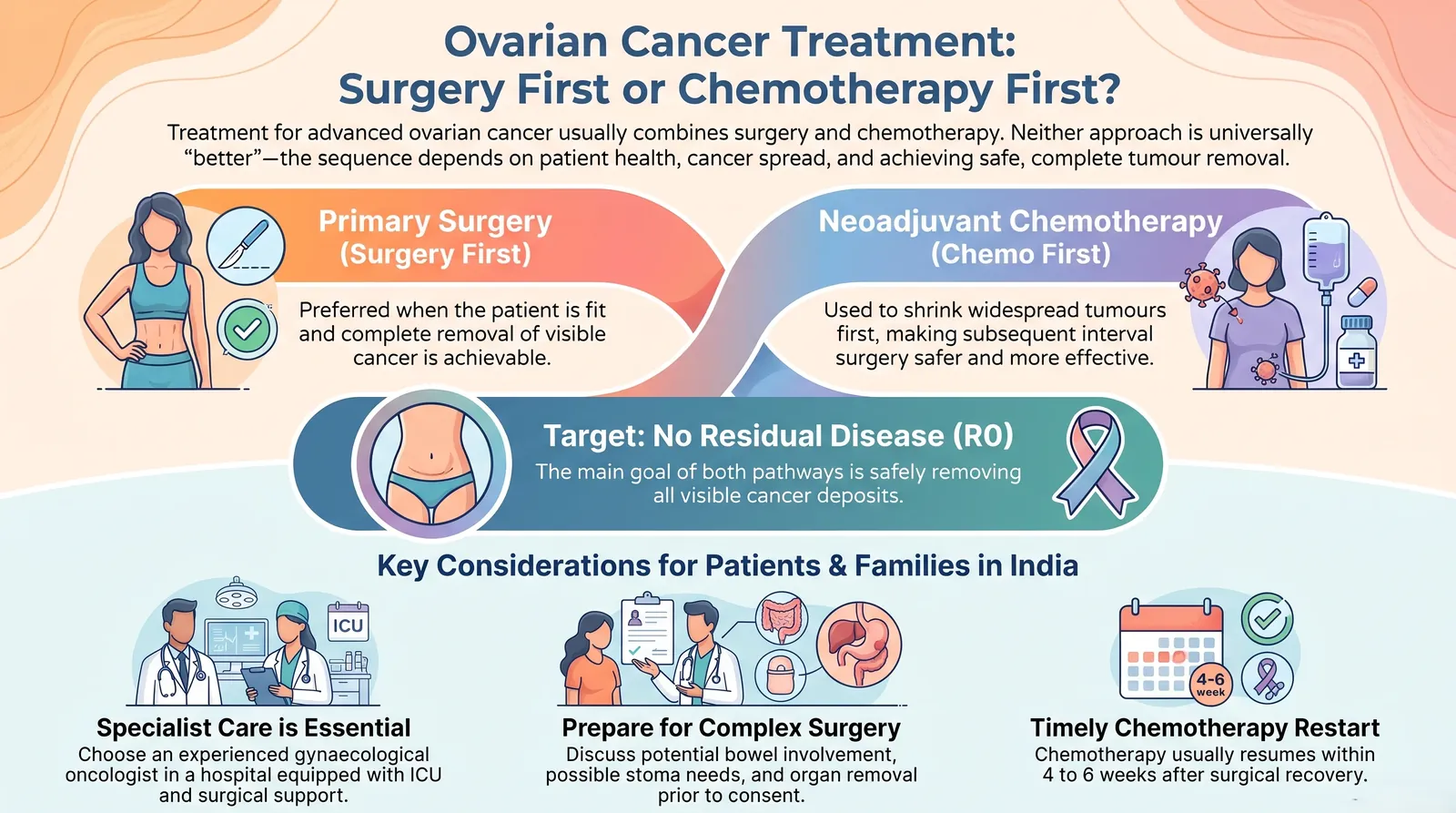
The main goal of both pathways is to remove all visible cancer safely.
Does every ovarian cancer need surgery?
Surgery is part of treatment for most women with epithelial ovarian cancer, the most common type. The exact operation depends on the stage.
In early-stage disease, surgery is usually the first step. It confirms the diagnosis, shows the exact stage and removes the tumour. In advanced disease (Stage III and IV), surgery first and chemotherapy first are both considered.
Surgery may not be suitable at the start if:
- The cancer is too widespread to remove safely.
- You are too unwell for a major operation.
- The cancer is growing despite treatment.
- The risks of surgery outweigh the likely benefit.
If surgery is not suitable at the start, that does not always mean it will never be possible. Some women become suitable for surgery after chemotherapy.
What is a frozen section test, and can it change the surgery?
A frozen section is a quick microscope check of tissue taken during the operation. It helps the surgeon decide how much surgery to do at that time. It is a provisional opinion, not the final diagnosis. The final report, made after the whole specimen has been examined, can confirm the frozen-section opinion or change it.
How is it done?
During the operation, the surgeon may send a piece of the suspicious ovarian tissue to the pathology laboratory while you are still under anaesthesia. The tissue is frozen, cut into very thin slices, stained and examined under a microscope. The pathologist then gives the surgeon a preliminary opinion: benign (not cancer), borderline, or malignant (cancer).
How can it change the operation?
- If the tumour looks benign, the surgeon may avoid extensive cancer surgery that is not needed. The operation can be limited to the affected area, depending on your age, symptoms and wishes about having children.[7]
- If the tumour looks borderline, it needs a different approach from invasive cancer. Staging and fertility-sparing options may be considered, particularly in younger women who want to keep their fertility, depending on the findings.[8]
- If the tumour looks malignant, the surgeon may go on to staging or cytoreductive surgery during the same operation, if this is safe and was agreed before the operation.[7]
Frozen section can change the plan. In one Indian study of 178 women, the surgery was changed from the planned procedure in about a quarter of them (26.9%) because of the frozen-section result.[9]
How accurate is it?
Frozen section is useful, but it is not perfect. A Cochrane review of 38 studies, involving 11,181 women with suspicious ovarian masses, found it reliable for clearly benign and clearly malignant tumours. When a result was benign, the final diagnosis was the same in about 94% of cases. When it was invasive cancer, the final diagnosis was the same in about 99% of cases. Borderline results are less reliable. About 21 in 100 women with a borderline frozen-section result were found to have cancer on the final report.[7]
Why can the frozen-section result differ from the final report?
- Only some tissue is examined during the operation. An ovarian tumour can be large and contain several different areas. The pathologist examines selected pieces, so the most abnormal area may not be included in the sample.[11]
- Mucinous tumours are particularly difficult. These tumours produce mucus-like material and can be very large. Mucinous tumours are particularly difficult, and they are often very large. In one Indian series, all of the cases where the two reports differed were mucinous tumours.[12]
- Borderline tumours can be hard to tell from invasive cancer. A borderline tumour does not show the destructive invasion that defines invasive cancer, and this can be difficult to see in a small sample. A borderline result can later turn out to be invasive cancer, so the final report matters.[13]
- The final report is based on more tissue. After surgery, the whole specimen is processed with a more detailed laboratory method, called permanent sections, and the pathologist can examine many more areas.[11] The final report may confirm the frozen-section opinion or change it.
A difference between the two reports does not automatically mean that the surgeon or the pathologist made a mistake. The two tests examine different amounts of tissue, and this is recognised particularly with large mucinous and borderline tumours.[10]
If the reports differ, what should you ask?
- Did the final report change the stage, the treatment plan or the need for another operation?
- Which areas of the tumour were examined, and why?
- Do I need further surgery or treatment now, or can we monitor it?
- Can I have copies of both the frozen-section report and the final report?
Frozen section is different from the biopsy taken before treatment. If chemotherapy is planned before surgery, the diagnosis is confirmed beforehand with a tissue sample taken before treatment starts. Our guide to understanding a cancer diagnosis explains how these reports fit together, and our article on ovarian cysts: benign or cancer? explains the scans and blood tests that come before surgery.
"A frozen-section report is a preliminary opinion, not the final diagnosis. The final pathology report guides the final treatment decision."
Should chemotherapy be given before surgery?
Sometimes, yes. This is a planned strategy, not a sign that nothing more can be done. The 2025 American Society of Clinical Oncology (ASCO) guideline update gives this broad guidance:[1]
- Women who are fit for surgery and have a good chance of complete removal should usually be offered surgery first.
- Women with high surgical risk, or a low chance of complete removal, should usually be offered chemotherapy first.
- Before chemotherapy starts, the diagnosis should be confirmed by a tissue sample (biopsy). A mass in the ovary is not always a primary ovarian cancer. It can be a cancer that has spread from another organ, which needs different treatment.
- The decision should be made by a gynaecological oncologist, ideally as part of a team that includes medical oncologists, radiologists and pathologists.
Large trials have not shown that one order is universally better. The TRUST trial, reported as a conference abstract at the ASCO Annual Meeting in 2025, compared surgery first with three cycles of chemotherapy followed by surgery in women with advanced disease.[2] Surgery first gave a longer time before the cancer started to grow again, and the benefit was clearest in women whose cancer was still confined to the abdomen (Stage III). The difference in overall survival was not statistically significant. Complete removal was achieved less often with surgery first in this trial, but women who had complete removal had the best outcomes. The trial was run in high-volume expert centres, so its results cannot be assumed for every hospital.
"Surgery first works best when complete removal is realistic. Chemotherapy first is a valid choice when it is not."
What is debulking surgery?
"Debulking" and "cytoreductive" surgery both mean reducing the amount of cancer in the body. The words describe the goal of the operation, not one fixed procedure.
- Primary debulking surgery is done before any chemotherapy.
- Interval debulking surgery is done after a course of chemotherapy, usually 3 to 4 cycles.
- Neoadjuvant chemotherapy is the chemotherapy given before surgery. "Neoadjuvant" simply means "given before the main treatment." It usually uses carboplatin and paclitaxel for advanced epithelial ovarian cancer, and it shrinks the tumour so that complete removal may become possible or safer.
Primary debulking may remove both ovaries and fallopian tubes, the uterus, the omentum (the fatty apron-like tissue in the abdomen), visible deposits on the lining of the abdomen and pelvis, and enlarged or suspicious lymph nodes. Parts of the bowel, diaphragm, spleen or other organs are removed only if they carry visible cancer and this can be done safely.
Primary or interval surgery: what is the difference?
- Primary surgery is done before chemotherapy. It suits fit patients with a realistic chance of complete removal. Chemotherapy usually follows the operation.
- Interval surgery is done after 3 to 4 cycles of chemotherapy. It suits patients with widespread disease, high surgical risk, or who were not fit for surgery at the start. Chemotherapy is given both before and after the operation.
- Interval surgery is not automatic. If the cancer has grown during chemotherapy, the team will review the plan again before going to surgery.
What does "no residual disease" mean?
"No residual disease" means the surgeon can see no visible cancer left behind at the end of the operation. It is the best surgical result in advanced ovarian cancer and is linked to better outcomes.
It refers to visible disease only. It does not mean that microscopic cancer cells have been eliminated, which is why chemotherapy is still needed after surgery. Older research used the terms "optimal" and "suboptimal" surgery, based on whether leftover deposits measured under or over 1 cm. The current aim is complete removal of everything visible. Ask your surgeon exactly what was removed and whether anything visible was left. The operation notes should record this.
Do both ovaries and the uterus need to come out?
In advanced cancer, both ovaries and fallopian tubes are usually removed (bilateral salpingo-oophorectomy), because cancer may be present in both ovaries or may have spread along the tubes. The uterus is removed (hysterectomy) when it is affected or when complete clearance is not possible without it. Your surgeon will decide based on the scans, the type and stage of the cancer, and whether fertility preservation is a realistic option.
Fertility-sparing surgery is possible only in carefully selected early-stage cases, so discuss it with your team before surgery. Removing both ovaries before natural menopause causes sudden surgical menopause. Symptoms such as hot flushes, poor sleep, vaginal dryness and mood changes can be treated, so tell your team if they trouble you.
Do lymph nodes need to be removed?
In early-stage cancer, lymph nodes are often sampled to check for spread, as part of staging. In advanced cancer, enlarged or suspicious nodes are removed if this can be done safely. Removing nodes that look normal is not routinely recommended.
The LION trial, published in the New England Journal of Medicine in 2019, tested this directly.[3] In women whose visible cancer had been fully removed and whose lymph nodes looked normal, removing all pelvic and para-aortic lymph nodes did not help women live longer or delay recurrence. It did increase serious complications, including repeat surgery and deaths within 60 days of the operation.
Can surgery involve the bowel, bladder or other organs?
Yes, in some patients. This is one of the most important things families should understand before surgery. Removing the ovarian tumour alone is sometimes not enough when cancer has spread to the bowel, the bladder or other surfaces.
- Bowel: A section of bowel may need to be removed, often reconnected in the same operation. Occasionally a temporary stoma (an opening on the abdomen connected to a collection bag) is needed, and many stomas are reversed later. Bowel surgery makes the operation longer and recovery slower, and the risk of leakage and infection must be discussed.
- Bladder: Cancer on the bladder surface or wall may be removed and the bladder repaired. A urinary catheter is needed while it heals. Involvement of the bladder does not automatically mean the whole bladder must be removed.
- Other organs: The spleen, diaphragm, the surface of the liver or parts of the stomach may be involved in advanced cases. These operations are done only when the visible deposits would otherwise remain and the expected benefit justifies the risk. Some operations need colorectal, upper gastrointestinal, hepatobiliary or urological surgeons on the same team.
Ask your team: "Is bowel surgery likely, and what are the chances of needing a stoma?"
Keyhole, robotic or open surgery?
Keyhole (laparoscopic) surgery is well established for early-stage cancer and for some staging procedures. In advanced cancer, a diagnostic keyhole look is sometimes used to decide whether complete removal is realistic. Keyhole surgery for interval debulking after chemotherapy is still being studied. A 2025 systematic review and meta-analysis found it appeared oncologically safe in selected patients.[4] Most included studies were observational, and the authors rated the evidence as low certainty, so randomised trials are still needed.
Robotic surgery is a form of minimally invasive surgery that uses a robotic system with magnified 3D vision. It can be considered in selected patients, but smaller incisions are not the same as proven survival benefit, and it should not be chosen if it would make complete removal less likely. Availability and experience vary between centres.
For extensive advanced disease, open surgery (a larger abdominal cut) is still the established approach, because it allows the surgeon to examine and treat the whole abdomen, including the upper abdomen, diaphragm, bowel and spleen. A bigger cut does not mean worse treatment. An operation that leaves visible cancer behind is not better than an open operation that removes it all.
What to expect in hospital and at home
The length of stay varies. A simpler operation may allow earlier discharge, while bowel surgery, a stoma, slow return of bowel function or complications add time. You are usually discharged when pain is controlled, you can eat and drink, and you can move around safely.
Recovery is different for every patient. Recovery after open surgery is often estimated at around 6 to 8 weeks, but tiredness can last longer, particularly after bowel surgery or several procedures. Where feasible, chemotherapy is usually restarted within about 4 to 6 weeks of surgery, because long delays are linked to poorer outcomes. This is not an absolute deadline, and your team will check your wound, bowel function, blood counts, kidney and liver function first.
Call your doctor promptly for fever, redness or discharge from the wound, severe or worsening abdominal pain, vomiting that does not stop, no bowel movement or wind for several days, leg swelling, breathlessness, or passing very little urine.
What if chemotherapy does not shrink the tumour?
Not all ovarian cancers respond equally. If the tumour does not shrink or grows during treatment, your team will review the biopsy, repeat the imaging and consider whether a different regimen or a clinical trial is appropriate. Progress during chemotherapy does not automatically mean surgery. The decision depends on whether complete removal is possible, your fitness, and the expected benefit and risks.
Does the type of ovarian cancer change the plan?
Yes. The surgery-first or chemotherapy-first discussion mainly applies to epithelial ovarian cancer, the most common type. Other types can need different treatment. Germ cell tumours, for example, are often very responsive to chemotherapy, and fertility-sparing treatment may be possible in selected young women. Borderline tumours are usually managed differently from invasive cancer.[5] The biopsy and pathology report are essential for choosing the right plan.
What comes after surgery and chemotherapy?
Some women are offered maintenance treatment to lower the risk of recurrence. This depends on tests such as BRCA1/2 status, homologous recombination deficiency (HRD) testing, the response to treatment and other clinical factors. Options can include PARP inhibitors or bevacizumab for selected patients, and not everyone needs or qualifies for these medicines.[5] Regular follow-up visits, scans and blood tests, including CA-125 where appropriate, continue afterwards. Report new symptoms early, such as persistent bloating, abdominal swelling, loss of appetite, pelvic pain or changes in bowel habits.
What families should ask before surgery
- Is the surgeon a gynaecological oncologist? Advanced ovarian cancer surgery is best done by a specialist in gynaecological cancer surgery.
- Has the disease been properly assessed? Scans should show whether complete removal is realistic.
- Has chemotherapy first been discussed? You should understand why one order is recommended over the other.
- Is multidisciplinary support available? Colorectal, urology, hepatobiliary surgery, anaesthesia and critical care may be needed.
- Has bowel surgery or a stoma been explained? You should know the possible extent of surgery before you sign the consent form.
- Has genetic testing been discussed? Women with epithelial ovarian cancer should be offered germline (inherited) and tumour (somatic) testing. The results can guide maintenance treatment and matter for family members.[6]
- Will a frozen-section test be done during the operation, and what will we do if the final report differs from it?
The key message
Surgery and chemotherapy are both essential tools. The right order depends on the spread of the cancer, the type of cancer, your health and the skill of the team. Surgery first works best when complete removal is realistic. Chemotherapy first, followed by interval surgery, is a valid plan when it is not. In both cases, the surgical goal is complete removal of visible cancer, done safely, and chemotherapy after surgery is still needed in most advanced cases.
You have every right to ask why a particular plan is recommended. Take your scan reports, biopsy results and questions to your consultation.
Frequently Asked Questions
References
- Gaillard S, Lacchetti C, Armstrong DK, et al. Neoadjuvant chemotherapy for newly diagnosed, advanced ovarian cancer: ASCO guideline update. Journal of Clinical Oncology. 2025.
- Mahner S, et al. TRUST: Trial of Radical Upfront Surgical Therapy in advanced ovarian cancer (ENGOT ov33/AGO-OVAR OP.7). ASCO Annual Meeting 2025, abstract LBA5500 (conference abstract).
- Harter P, Sehouli J, Lorusso D, et al. A randomized trial of lymphadenectomy in patients with advanced ovarian neoplasms. New England Journal of Medicine. 2019;380(9):822–832.
- Outcome after laparoscopic compared to open interval debulking surgery for advanced stage ovarian cancer: a systematic review and meta-analysis. Cancers. 2025.
- National Cancer Institute. Ovarian Epithelial, Fallopian Tube, and Primary Peritoneal Cancer Treatment (PDQ), Health Professional Version. cancer.gov.
- González-Martín A, Harter P, Leary A, et al. Newly diagnosed and relapsed epithelial ovarian carcinoma: ESMO Clinical Practice Guideline. Annals of Oncology. 2023;34(10):833–848.
- Ratnavelu ND, Brown AP, Mallett S, et al. Intraoperative frozen section analysis for the diagnosis of early stage ovarian cancer in suspicious pelvic masses. Cochrane Database of Systematic Reviews. 2016;(3):CD010360. doi:10.1002/14651858.CD010360.pub2
- Morice P, Scambia G, Abu-Rustum NR, et al. Fertility-sparing treatment and follow-up in patients with cervical cancer, ovarian cancer, and borderline ovarian tumours: guidelines from ESGO, ESHRE, and ESGE. Lancet Oncology. 2024;25(11):e602–e610. doi:10.1016/S1470-2045(24)00262-6.
- Rajanbabu A, Nair IR, Goel G, et al. Evaluating the impact of frozen section analysis in surgery for ovarian neoplasms. Indian Journal of Gynecologic Oncology. 2015;13:7. doi:10.1007/s40944-015-0007-3.
- Chaudhary S, Raghuvanshi S, Singh N, et al. Frozen section-histopathology correlation in gynecologic pathology: a tertiary care centre experience. Bioinformation. 2026;22(7):4512–4516.
- Buza N. Frozen section diagnosis of ovarian epithelial tumors: diagnostic pearls and pitfalls. Archives of Pathology and Laboratory Medicine. 2019;143(1):47–64.
- An evaluation of frozen section and lymph node dissection results for mucinous ovarian tumors. International Journal of Gynecological Cancer. 2018;28(1):92–98. doi:10.1097/IGC.0000000000001150.
- Borderline ovarian tumor frozen section diagnoses with features suspicious of invasive cancer: a retrospective study. Journal of Ovarian Research. 2021. doi:10.1186/s13048-021-00897-8.
Related Reading

Planning surgery for ovarian cancer?
Dr. Dipanwita Banerjee offers consultations at CNCI Kolkata for the evaluation and surgical planning of ovarian cancer.