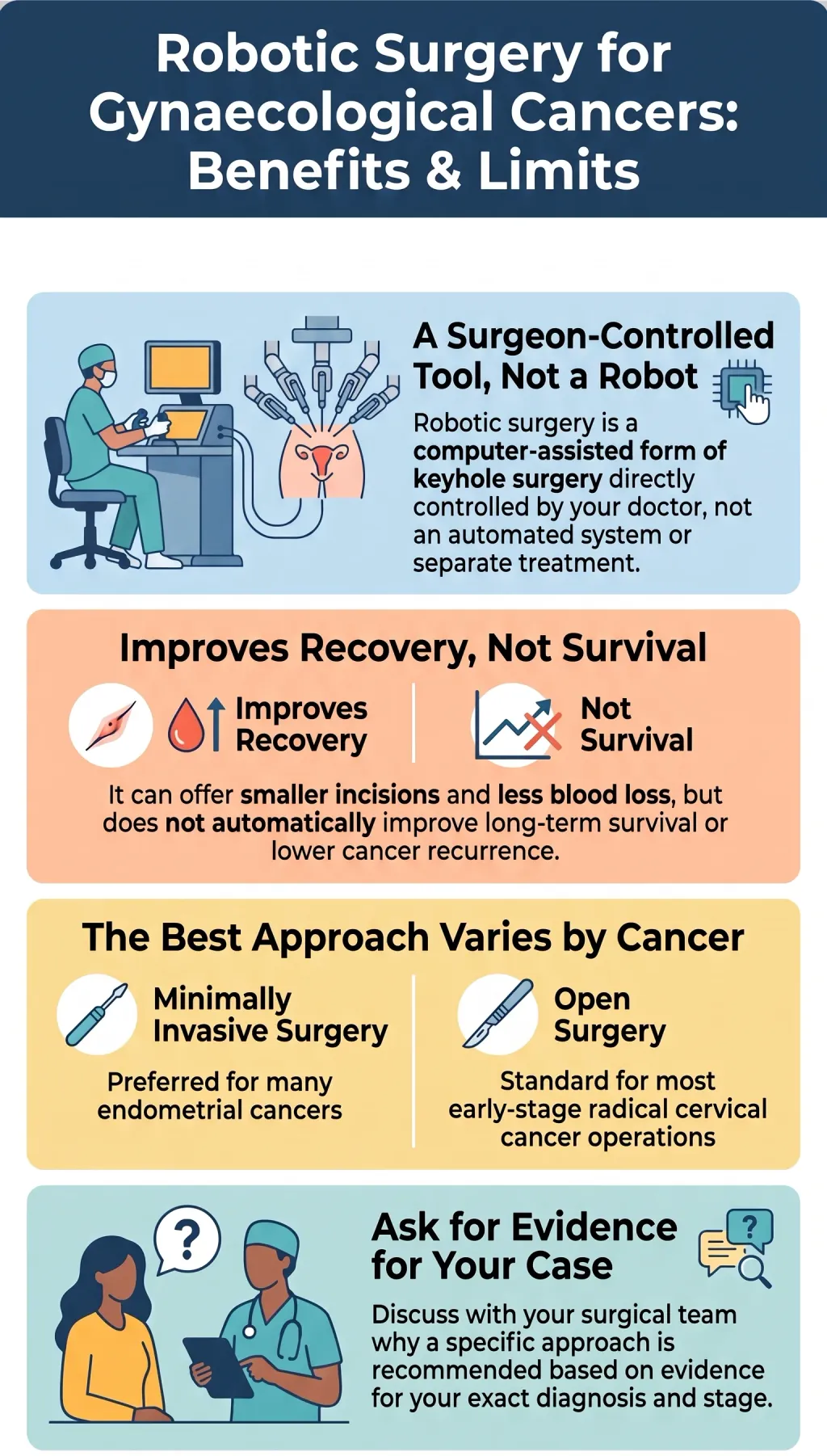
The infographic labels are in English.
Robotic surgery is increasingly offered for gynaecological cancers. Patients often hear that it means smaller cuts, less blood loss, less pain and a quicker recovery. Some of this is true, in some operations. But it is only half of the question. The other half is whether the operation removes the cancer as effectively as other surgical approaches for your particular cancer, stage and operation.
Robotic surgery can offer practical advantages in selected patients. It is not automatically safer, more effective or better for every gynaecological cancer. The right approach depends on the type and stage of cancer, the operation needed, your general health, the surgeon's experience with that specific operation, and the evidence available for it.
This guide covers endometrial (uterine lining), cervical and ovarian cancer. Other uterine cancers, such as uterine sarcomas, are different conditions and are not covered here. Unfamiliar terms are explained in the A to Z glossary.
Key points
- Robotic surgery is a way of doing keyhole (minimally invasive) surgery. It is not a separate cancer treatment.
- Compared with open surgery, minimally invasive operations can mean smaller incisions, less blood loss and a shorter hospital stay in suitable cases.
- Compared with conventional laparoscopy, the differences are usually small, and cancer outcomes in endometrial cancer have been similar.
- In early-stage cervical cancer needing radical hysterectomy, open surgery remains the standard approach, because a randomised trial found worse cancer outcomes with minimally invasive surgery.
- In ovarian cancer, the main goal is correct staging or removal of all visible tumour. The surgical platform comes second.
What is robotic surgery?
Robotic surgery is a form of minimally invasive surgery in which the surgeon controls specialised instruments through a computer-assisted system. The surgeon sits at a console and views the operating area through a magnified three-dimensional camera. The instruments, held on mechanical arms, move in response to the surgeon's hand controls.
Despite the name, it is not a robot that operates by itself. The US Food and Drug Administration (FDA) notes that the system cannot perform surgery without direct human control.[1]
There are three main ways to perform many gynaecological operations:
- Open surgery: the surgeon operates through a larger abdominal incision.
- Conventional laparoscopic surgery: the surgeon operates through small incisions, holding long instruments and a camera directly.
- Robot-assisted surgery: the surgeon operates through small incisions, controlling instruments mounted on a robotic system.
Robot-assisted and laparoscopic surgery are both "minimally invasive". Robotic systems may be used for operations such as hysterectomy, lymph-node removal and some staging procedures.
What can robotic surgery improve?
The benefits relate mainly to how the operation is done and how you recover in the short term. The size of any benefit depends on the operation, the patient and what it is being compared with.
Smaller incisions
Compared with open surgery, minimally invasive operations use several small incisions rather than one larger cut. This may reduce wound problems and improve comfort. Whether an operation can be completed this way depends on the findings during surgery.
Less blood loss
In endometrial cancer, a 2026 meta-analysis found that robotic surgery was associated with less blood loss than conventional laparoscopy, although the absolute differences were small.[3] A larger body of studies reached a similar finding.[4]
In the RACC randomised trial in early-stage cervical cancer, the median blood loss was 75 mL with robotic surgery and 250 mL with open surgery.[11]
A shorter hospital stay than open surgery
A 2024 network meta-analysis in endometrial cancer found that laparoscopic and robotic surgery both reduced blood loss and hospital stay compared with open surgery, but took longer to perform.[5] Compared with conventional laparoscopy, hospital stay has generally been similar.[3]
Fewer conversions to open surgery in some studies
Sometimes the surgeon has to switch to open surgery to complete an operation safely. In endometrial cancer, a 2026 meta-analysis of 30 studies (two randomised trials and 28 observational studies, 10,673 patients) found lower conversion rates with robotic surgery than with conventional laparoscopy.[4] Conversion is a safety decision, not a failure.
Most of the evidence comes from observational studies, so these results should be read with care. They do not show that robotic surgery prevents conversion in every type of operation.
Visualisation and instrument control
The robotic system provides 3D vision and instruments that can help the surgeon work in confined spaces.[1] These are technical advantages. Better visualisation does not by itself prove that cancer is less likely to come back.
What does robotic surgery not automatically improve?
It does not automatically improve survival
Cancer outcomes depend on the type and stage of cancer, tumour biology, the appropriateness and completeness of the operation, and any other treatment needed.
In endometrial cancer, a 2026 meta-analysis found no significant difference in recurrence, progression-free survival or overall survival between robotic and conventional laparoscopic surgery.[3]
The FDA also points out that its clearances of robotic devices for operations such as hysterectomy are based on short-term (30-day) follow-up, and that the effect on cancer outcomes such as survival and recurrence has not been established by those clearances.[1]
It does not guarantee less pain or faster recovery
Recovery after minimally invasive surgery is often quicker than after open surgery, but pain and recovery vary with the extent of the operation, your general health and whether complications occur.
In the RACC trial of cervical cancer surgery, complications within 30 days of surgery were similar between robotic and open surgery (33.4% and 34.8%). Quality-of-life differences at one month were small.[11]
It does not remove surgical risks
Robotic surgery can still cause bleeding, infection, injury to the bladder, bowel, ureters or blood vessels, blood clots and anaesthetic complications. The risks depend on the operation, your health and the experience of the whole surgical team.
It is not always quicker
In the RACC trial, the median operating time was longer with robotic surgery (237 minutes) than with open surgery (209 minutes).[11] Operating time varies with the procedure, the surgeon's experience and your anatomy.
It is not always cheaper
Robotic systems need substantial investment, maintenance, specialised instruments and trained teams, and these costs can affect the total price of treatment. Whether there is any overall cost difference depends on factors such as hospital stay, complications and local arrangements.
Ask for the full estimated cost, including hospital charges, consumables, tests and follow-up, and not just the surgeon's fee. You may also wish to ask whether your insurance covers the robotic component.
Is robotic surgery suitable for every gynaecological cancer?
No. It depends on the cancer and the operation.
| Cancer | Role of minimally invasive (including robotic) surgery | Main point |
|---|---|---|
| Endometrial | Established and preferred approach where suitable[2] | Robotic and laparoscopic approaches have given similar cancer outcomes[3] |
| Cervical | Open surgery remains standard for radical hysterectomy[8][9] | Randomised evidence favoured open surgery; robotic-specific trials are in progress[6][8][11][12] |
| Ovarian | Used in selected situations only[13][14] | Complete staging or tumour removal comes first[14] |
Endometrial cancer (cancer of the uterine lining)
Surgery usually involves removing the uterus, and often the ovaries and fallopian tubes. Lymph-node assessment may be needed according to the risk profile of the cancer.
The 2025 ESGO–ESTRO–ESP guideline on endometrial cancer names minimally invasive surgery as the preferred surgical approach where it is feasible and there is no contraindication.[2] Robotic surgery is one way of performing minimally invasive surgery.
Potential advantages over open surgery include smaller incisions, less blood loss and a shorter hospital stay.[5] Compared with conventional laparoscopy, recent meta-analyses show equivalent cancer outcomes, with less blood loss and fewer conversions to open surgery in the robotic groups.[3][4]
Cervical cancer
For cervical cancer, the evidence on surgical approach is different from endometrial cancer, and it needs a separate discussion. Some early-stage cervical cancers are treated with a radical hysterectomy, which removes the uterus, cervix and surrounding tissues. The choice of approach in this operation has important consequences for cancer control.
The LACC trial randomly assigned 631 women with early-stage cervical cancer to minimally invasive or open radical hysterectomy. Minimally invasive surgery was associated with lower disease-free survival and lower overall survival.[6] A registry study published alongside it also found shorter survival after minimally invasive surgery.[7] In the final analysis, overall survival at 4.5 years was 90.6% with minimally invasive surgery and 96.2% with open surgery.[8]
Two points are worth understanding:
- In LACC, most of the minimally invasive operations were conventional laparoscopic, with only a minority robot-assisted.[10] Whether robotic surgery differs is being tested in two randomised trials, RACC and ROCC. The cancer outcomes of RACC have not yet been reported, and ROCC is still recruiting.[11][12]
- The first RACC results, published in October 2026, covered short-term outcomes only. Robotic surgery had fewer intraoperative complications (5.7% versus 10.0%), mostly minor, with similar complication rates in the following 30 days. These results do not show whether the cancer outcomes are similar.[11]
Given this, the ESGO–ESTRO–ESP cervical cancer guideline recommends radical surgery by a gynaecological oncologist. It says that a minimally invasive approach may be considered only for low-risk tumours (under 2 cm, with clear margins after cone biopsy), in high-volume centres experienced in the technique, and only if the patient agrees after a full discussion of the current evidence.[9] The same guideline accepts minimally invasive surgery for lymph-node staging.[9]
Not every cervical cancer operation is a radical hysterectomy. Treatment depends on stage, and may involve less extensive surgery, radiotherapy or chemotherapy. In the SHAPE trial, a simple hysterectomy was as safe as a radical hysterectomy for the pelvic recurrence rate at 3 years in women with carefully selected low-risk tumours. In that trial the surgeon chose between open and minimally invasive approaches, and the trial was not designed to compare them.[10]
Evidence for this and for the open-versus-minimally-invasive question should not be mixed up with the evidence for endometrial cancer. They are different clinical questions.
Ovarian cancer
Ovarian cancer surgery ranges from staging operations in early disease to extensive surgery for advanced disease. In advanced ovarian cancer, the most important goal of surgery is to remove all visible tumour when that can be done safely.[14] That can require work in several areas of the abdomen and pelvis, and decisions about it are best made at a specialist centre by a multidisciplinary team.[14] Robotic surgery should not be chosen if it compromises that goal.
In early-stage disease, the 2024 ESGO–ESMO–ESP recommendations accept minimally invasive surgery in defined situations. For example, it is acceptable for women who wish to preserve fertility, provided the tumour is not ruptured during surgery.[13] It can also be used for restaging operations.[14]
For primary or interval cytoreduction in advanced disease, a lack of randomised trials means the safety of laparoscopic or robotic approaches cannot be stated with certainty.[15] Evidence from one selected group should not be generalised to all patients.
Does robotic surgery remove the cancer more completely?
Not necessarily. How completely a cancer can be removed depends on where it is, how far it has spread, its biology, your general condition and the surgical team's expertise.
Robotic instruments can help with movements in confined spaces. They cannot guarantee clear margins, complete removal of visible disease or freedom from recurrence.
The right question is not "Can this cancer be operated on robotically?" It is: "Can the required cancer operation be performed safely and adequately using this approach in my case?"
Is robotic surgery safer than open surgery?
There is no single answer for every gynaecological cancer.
For many endometrial cancer operations, minimally invasive approaches reduce some short-term burdens of open surgery.[5] Robotic assistance is one way to achieve this. The comparison changes with the operation. For early-stage cervical cancer needing radical hysterectomy, cancer outcomes in the LACC trial favoured open surgery.[6][8]
Open surgery has its own risks, including a larger wound, wound complications, pain and often a longer recovery. It may still be the better choice when the cancer operation requires it. A sound decision weighs short-term surgical risks and long-term cancer outcomes together. The least invasive operation is not automatically the safest overall option.
Does robotic surgery reduce the chance of cancer coming back?
That depends on the cancer, stage and operation.
- Endometrial cancer: minimally invasive surgery is supported in many settings. Robotic surgery has not been shown to reduce recurrence or improve survival compared with conventional laparoscopy.[3]
- Early-stage cervical cancer treated with radical hysterectomy: the LACC findings are an important reason not to assume that minimally invasive surgery has the same cancer outcomes as open surgery.[6][8]
- Ovarian cancer: appropriate staging and complete removal of tumour are central. The surgical platform should not take priority over them.[14]
Ask your treating team what evidence supports the approach they propose for your cancer and stage.
Who may be a candidate for robotic surgery?
Suitability depends on several factors:
- The type and stage of the cancer.
- The operation required, including whether lymph-node assessment or extensive tumour removal is needed.
- The location and extent of the tumour.
- Earlier abdominal or pelvic surgery and any scar tissue (adhesions) from it.
- Other medical conditions and your fitness for surgery.
- The surgeon's training and experience with the proposed operation.
- The hospital's equipment, team experience and ability to manage complications.
- Whether the approach is supported by current evidence for that particular operation.
Being suitable for surgery does not automatically mean being suitable for robotic surgery. Equally, not being offered robotic surgery does not mean the treatment is inferior.
What questions should I ask before choosing robotic surgery?
- What is my exact diagnosis and stage?
- What operation do I need, and what is it meant to achieve?
- Why are you recommending robotic, laparoscopic or open surgery for me?
- What evidence supports this approach for my cancer and stage?
- What are the likely benefits and risks compared with the alternatives?
- How much experience do you have with this specific operation, and not just with robotic surgery in general?
- How likely is it that you would need to change to open surgery, and in what circumstances?
- Will this approach allow adequate tumour removal and staging?
- What is the full estimated cost, including hospital stay, instruments, tests and follow-up, and what does my insurance cover?
- If robotic surgery is not appropriate for me, what do you recommend instead and why?
A good discussion explains why an approach suits you as an individual, and does not rely on general claims about the technology.
Is robotic surgery worth the extra cost?
There is no universal answer. For some patients, robotic surgery provides useful practical benefits, particularly when a minimally invasive operation is appropriate but technically demanding. For others, conventional laparoscopy gives similar results, or open surgery is needed for the cancer operation.
The value of robotic surgery should be judged on the benefits it is likely to give in your case, its risks, the surgeon's experience and the additional cost. Choosing a non-robotic operation does not mean choosing outdated or inferior treatment. A well-selected, well-performed operation using the right approach matters more than the name of the technology.
Frequently Asked Questions
Is robotic surgery better than laparoscopic surgery for gynaecological cancer?
Not universally. In endometrial cancer, robotic surgery has been associated with less blood loss and fewer conversions to open surgery, but cancer outcomes have been similar. The comparison depends on the cancer, the procedure and the surgeon's experience.
Is robotic surgery better than open surgery?
For many suitable endometrial cancer operations, minimally invasive surgery offers recovery-related advantages over open surgery. For early-stage cervical cancer needing radical hysterectomy, open surgery remains the standard approach. The choice must consider both recovery and cancer outcomes.
Is robotic surgery a cancer treatment in itself?
No. It is a surgical technique. The cancer operation, the stage of disease, how completely the tumour is removed and any other treatment you need determine the overall plan.
Does robotic surgery mean fewer complications?
Not necessarily. It may reduce some complications in some settings, for example fewer minor intraoperative events in the RACC trial, but complications in the 30 days after surgery were similar to open surgery. The same broad categories of risk apply to all approaches.
Can robotic surgery be used for advanced ovarian cancer?
Extensive advanced ovarian cancer often needs an operation that allows complete assessment and removal of tumour deposits. Minimally invasive or robotic approaches may be considered in selected situations, but should not compromise complete and appropriate tumour removal.
Why is open surgery still the standard in some cervical cancers?
In the LACC randomised trial, women with early-stage cervical cancer who had minimally invasive radical hysterectomy had lower disease-free and overall survival than those who had open surgery. Guidelines therefore recommend open radical hysterectomy as the standard, with limited exceptions for low-risk tumours in experienced high-volume centres after a full discussion.
Does robotic surgery guarantee faster recovery?
No. Many patients recover sooner after minimally invasive surgery than after open surgery, but recovery depends on the operation, your health and whether complications occur.
The key message
Robotic surgery is a useful tool for selected gynaecological cancer operations, but it is not automatically the best choice for every patient.
It can mean smaller incisions and, in some settings, less blood loss and fewer conversions to open surgery. It does not remove surgical risks, and by itself it has not been shown to improve cancer control or survival.
The evidence differs by cancer type. Minimally invasive surgery is the preferred approach for many endometrial cancer operations. Early-stage cervical cancer needing radical hysterectomy calls for particular caution, because randomised evidence favoured open surgery. In ovarian cancer, the extent of disease and the ability to stage or remove tumour adequately drive the decision.
The best approach is the one that safely achieves the required cancer operation, is supported by evidence for your diagnosis and stage, and is performed by an experienced team.
This article is for general education and does not replace individual medical advice. Please discuss your options, the benefits and risks of each approach, and the costs with your treating gynaecological oncologist.
References
- U.S. Food and Drug Administration. Computer-Assisted Surgical Systems. Content current as of 24 September 2026. Link
- Concin N, et al. ESGO–ESTRO–ESP guidelines for the management of patients with endometrial carcinoma: update 2025. Lancet Oncol. 2025;26(8):e423–e435.
- Kalas N, et al. Robotic-assisted surgery versus conventional laparoscopy in endometrial cancer: a systematic review and meta-analysis. Eur J Surg Oncol. 2026;52(8):111861.
- Majeed K, et al. Robot-assisted versus conventional laparoscopic surgery for endometrial cancer: an updated systematic review and meta-analysis. BMC Surg. 2026;26(1):475.
- Surgical treatment for endometrial cancer, hysterectomy performed via minimally invasive routes compared with open surgery: a systematic review and network meta-analysis. Cancers. 2024.
- Ramirez PT, et al. Minimally invasive versus abdominal radical hysterectomy for cervical cancer (LACC). N Engl J Med. 2018;379:1895–1904.
- Melamed A, et al. Survival after minimally invasive radical hysterectomy for early-stage cervical cancer. N Engl J Med. 2018;379:1905–1914.
- Ramirez PT, et al. LACC trial: final analysis on overall survival comparing open versus minimally invasive radical hysterectomy for early-stage cervical cancer. J Clin Oncol. 2024;42(23):2741–2746.
- ESGO/ESTRO/ESP guidelines for the management of patients with cervical cancer – update 2023. Int J Gynecol Cancer. 2023;33:649–666.
- Plante M, et al. Simple versus radical hysterectomy in women with low-risk cervical cancer (SHAPE). N Engl J Med. 2024;390:819–829.
- Salehi S, et al. Perioperative outcomes and recovery after robot-assisted vs open radical hysterectomy: a secondary analysis of the RACC randomized clinical trial. JAMA Surg. Published online 7 October 2026.
- ClinicalTrials.gov. ROCC/GOG-3043: Robotic versus open hysterectomy surgery in cervix cancer (NCT04831580). Status recruiting. Link
- Ledermann JA, et al. ESGO–ESMO–ESP consensus conference recommendations on ovarian cancer: pathology and molecular biology and early, advanced and recurrent disease. Ann Oncol. 2024.
- Colombo N, et al. ESMO–ESGO consensus conference recommendations on ovarian cancer: pathology and molecular biology, early and advanced stages, borderline tumours and recurrent disease. Ann Oncol. 2019.
- Giannini A, Laganà AS. Editorial: Minimally invasive surgery in gynecology oncology: current trends and controversies. Front Med. 2024.
Related Reading

Not sure whether robotic surgery is right for your cancer?
Dr. Dipanwita Banerjee offers consultations at CNCI Kolkata to explain which surgical approach suits your diagnosis and stage, and why.