
When treatment is not working as hoped, support matters as much as the next medical decision.
Few things are harder for a family than hearing that ovarian cancer has not responded as expected, has come back, or is still growing despite chemotherapy. A daughter may ask whether her mother will survive. A husband may wonder whether another hospital should be tried, or whether the family is giving up too soon. The patient may be carrying a question she has not said aloud: how much more can I take?
These thoughts are normal. This article explains what the stage and scan results mean, how doctors judge whether treatment is working, which options may remain, and how families can approach hard decisions. It is general information. It cannot replace a review of her own records by her treating team.
When treatment stops working, what comes next?
Other options may still exist. Depending on the cancer, its earlier treatment and her condition, another medicine, a clinical trial or, in selected cases, another procedure may help control the disease for a time. When further cancer treatment is unlikely to help, the focus moves to comfort, dignity and time together, which is still active care.
- When one treatment stops working, other options may still exist. The right next step depends on the type of cancer, what she has already had and how well she is.
- Sometimes further cancer treatment is unlikely to help. That does not mean nothing can be done. Pain, breathlessness, nausea, weakness, anxiety and sleep problems can all be treated.
- Palliative care is part of care at every stage, not only at the end.
What does the stage mean?
Ovarian cancer is staged using the international FIGO system, which describes how far the disease has spread. Stage 3 means the cancer has spread within the abdomen beyond the pelvis, or to lymph nodes behind the lining of the abdomen. Stage 4 means it has spread to distant areas, such as the fluid around the lungs, the tissue of the liver or spleen, or lymph nodes outside the abdomen. Ask the team whether the stage was confirmed at surgery or is based on scans.
Stage 3 is advanced, but it is not automatically incurable. Many women respond well to surgery and chemotherapy, and some reach long remission. Stage 4 is generally harder to cure, but it can often be controlled for a meaningful period. What matters most is how much visible cancer can be removed, how well it responds to platinum chemotherapy, the biology of the tumour, and her general health. No stage alone predicts an individual's future.
What do survival figures really mean?
The most widely quoted figures come from the US National Cancer Institute's SEER database, using 2015 to 2021 data. SEER groups ovarian cancer by how far it has spread rather than by FIGO stage. The five-year relative survival is about 92% when the cancer is confined to the ovary, about 71% when it has spread to nearby structures or lymph nodes, and about 32% when it has spread to distant areas.[1]
- They describe populations, not individuals. A five-year relative survival rate compares people with the cancer to people of similar age and sex in the general population. It does not mean a woman will live exactly five years.
- They are not stage-specific. SEER groups do not match FIGO stages 3A, 3B, 3C or 4, so they cannot be read as the survival rate for stage 3C or stage 4 disease.
- They are US figures at the time of diagnosis. They do not describe a woman whose cancer has already come back or progressed.
Better questions for the oncologist are: what is the realistic goal of treatment for her, what would be a good outcome and what would be a concerning one, what signs would suggest that time may be shorter than we hope, and what can we do now to make good days count?
How doctors judge whether treatment is working
Doctors use several measures together. Less bloating, less pain, a better appetite and easier walking are encouraging, though symptoms alone do not prove that the cancer has gone. CA-125, a blood protein often raised in epithelial ovarian cancer, is tracked over time. A falling level is encouraging, but it is only one piece of information. CT scans, and sometimes MRI or PET-CT, show whether visible disease has shrunk, stayed the same, grown or appeared in new places.
A CA-125 that does not fall as expected deserves attention, but it does not automatically mean that treatment has failed. A single raised result should rarely decide the plan. The team will usually repeat the test, review symptoms and arrange imaging before changing anything. A sustained rise, especially with new symptoms or growth on scans, needs prompt review.
"A tumour marker is one part of the picture, not the whole picture."
Chemotherapy, cycles and surgery
Platinum-based chemotherapy, most often carboplatin with paclitaxel, can shrink ovarian cancer substantially in many women. It may be given before surgery, after surgery, for a recurrence, or to control symptoms when surgery is not suitable. For advanced disease, about six cycles of platinum-based chemotherapy in total is a common plan.[2]
When chemotherapy comes first, the usual pattern is about three to four cycles, then reassessment of the disease and her fitness, then surgery if it looks appropriate, then the remaining cycles. Surgery after chemotherapy is called interval surgery. The 2025 ASCO guideline recommends it after four or fewer cycles, for women who have responded or whose disease is stable.[2] If the cancer is clearly growing during chemotherapy, surgery is usually not the next step, and the plan should be reviewed first.
Surgery first or chemotherapy first depends on fitness and on how likely it is that all visible disease can be removed. The same guideline recommends surgery first for women who are fit and likely to have complete removal, and chemotherapy first for women who are fit but unlikely to achieve it, or who have a high surgical risk.[2] The 2010 European trial EORTC 55971 found that chemotherapy followed by surgery was not inferior to surgery followed by chemotherapy in women with advanced ovarian cancer.[3] So chemotherapy first does not mean the cancer is hopeless.
When chemotherapy is not working
This is a moment for careful review, not for panic and not for an automatic decision to repeat the same treatment. The team first needs to know whether the cancer is stable, growing slowly or quickly, spreading to new places, or causing new symptoms. Each situation calls for a different response. The oncologist may:
- Review the original biopsy and pathology reports.
- Compare the latest scans with earlier ones, and confirm that progression is real.
- Check how well she has recovered from earlier treatment, and which drugs have already been used.
- Complete genetic and molecular tests if they have not been done.
- Consider another chemotherapy, a targeted treatment, a clinical trial, or care focused on symptoms.
A repeat biopsy may help in some cases. A treatment plan should change because the evidence and her circumstances justify it. It should not change only because a family is frightened by one scan or one blood result.
Platinum-sensitive or platinum-resistant?
A recurrence means the cancer has returned after a period of response. It may appear in the abdomen, the bowel lining, lymph nodes, the pelvis or distant organs. A recurrence does not automatically mean that treatment has ended. Options depend on how long it has been since the last platinum treatment, which treatments she has had, where the cancer is, her fitness and her wishes. The two terms below describe how the cancer behaves with platinum drugs such as carboplatin:
- Platinum-sensitive means the cancer returned more than six months after the last platinum treatment. It may respond to platinum-based chemotherapy again.
- Platinum-resistant means it returned within six months, or grew during platinum treatment. It usually needs a different approach.
The six-month cut-off is a traditional guide, not a biological dividing line. For platinum-sensitive recurrence, the 2026 ASCO living guideline strongly recommends one of three platinum-based combinations: pegylated liposomal doxorubicin with carboplatin, paclitaxel with carboplatin, or gemcitabine with carboplatin.[4]
Repeat surgery, called secondary cytoreduction, may be considered for selected women with platinum-sensitive recurrence, particularly when the disease-free interval is long, the recurrence is limited and complete removal of visible disease looks achievable. For platinum-resistant disease, the same guideline found insufficient evidence to recommend secondary surgery or HIPEC.[4] Ask for an opinion from a gynaecological oncologist with experience in ovarian cancer surgery before accepting an operation. Partial removal of widespread disease may not bring the benefit the family hopes for.
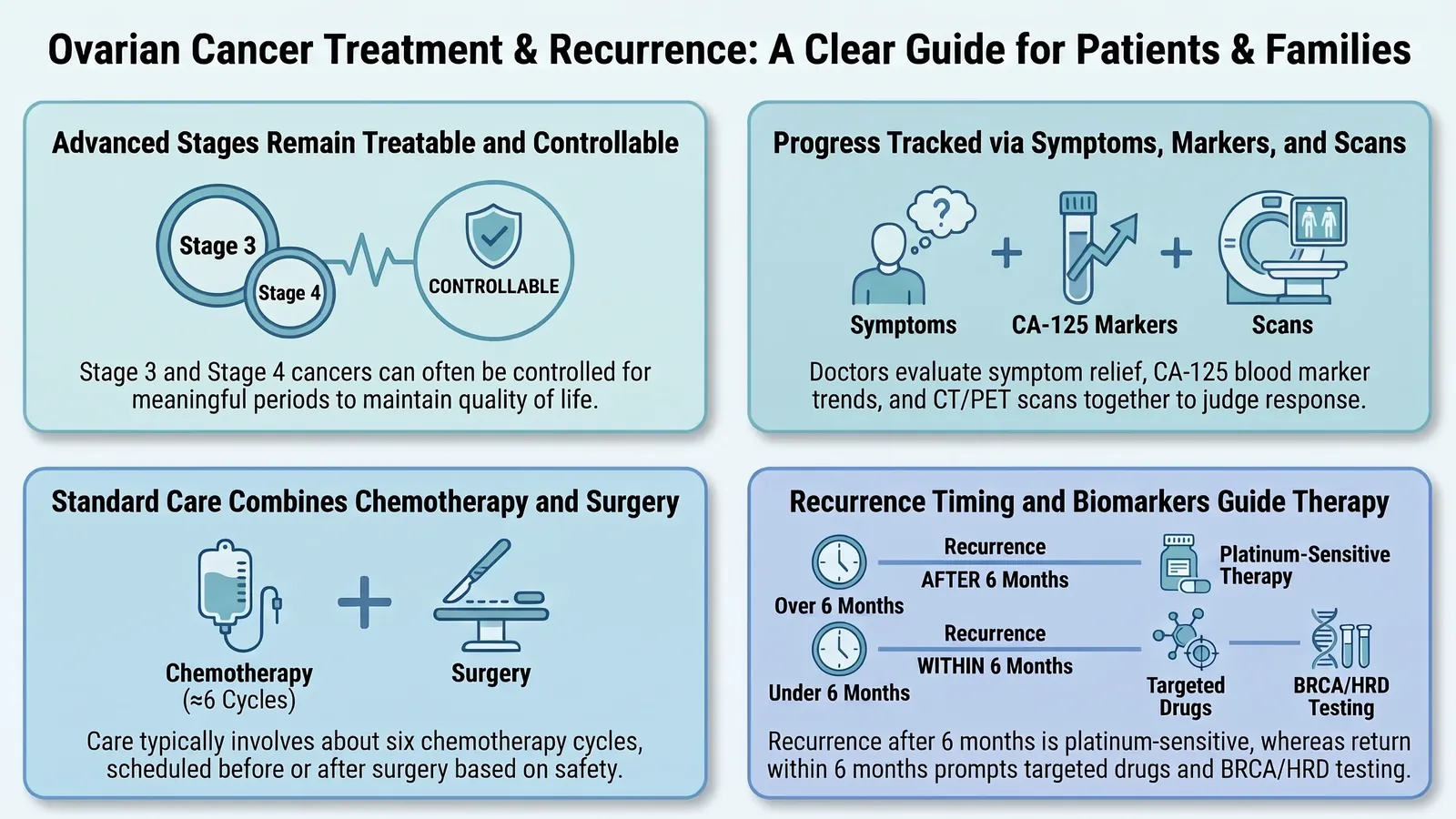
A summary of how progress is tracked and how the timing of recurrence guides treatment.
Newer treatments and what they can and cannot do
Targeted treatments act on specific features of the cancer. They are not interchangeable, not every woman qualifies, and many are costly. Much of the evidence comes from high-grade serous and endometrioid cancers, and other types may need different approaches. Check availability with the treating team.
- PARP inhibitors (olaparib, niraparib, rucaparib) are tablets most useful for women whose cancer has a BRCA mutation or other homologous recombination deficiency, usually as maintenance after a good response to platinum. Their use is now more selective,[4] and blood counts are monitored because of the risk of low counts (why they fall and what is done).
- Bevacizumab blocks a protein that helps tumours build blood vessels. It may be added to chemotherapy in selected women. Blood pressure, bleeding and clotting risks, and recent surgery are considered before use.
- Mirvetuximab soravtansine is an antibody-drug conjugate for platinum-resistant, high-grade disease whose tumour shows high folate receptor alpha (FRα) on a validated test. The ASCO 2026 guideline strongly recommends it for high expression, defined as at least 75% of tumour cells showing strong staining.[4] In the phase 3 MIRASOL trial, it delayed progression compared with standard chemotherapy.[5] Side effects include eye problems, nerve changes and tiredness, so eye checks are part of its care.
- Relacorilant with nab-paclitaxel was approved by the US Food and Drug Administration on 25 March 2026 for adults with platinum-resistant disease who have had one to three earlier treatment regimens, at least one of which included bevacizumab. In the phase 3 ROSELLA trial, median overall survival was 16 months with the combination, compared with 11.9 months with nab-paclitaxel alone.[6] It is not suitable for women who need corticosteroids for a life-saving reason.
- Pembrolizumab with paclitaxel was approved by the US FDA in February 2026 for a PD-L1-selected, platinum-resistant group. The ASCO guideline discusses it as emerging evidence.[4]
Availability in India and the UK. In March 2026, India's Subject Expert Committee recommended permission to import and market mirvetuximab, subject to conditions including approval of its companion diagnostic test before marketing.[7] A recommendation is not the same as the drug being available in pharmacies or hospitals. In the UK, NICE published final guidance in June 2026 recommending mirvetuximab for use on the NHS in England, for this group of patients, within its licence.[8] Approval elsewhere does not establish availability or insurance cover in India. Ask the oncologist about current status, FRα testing, access and cost.
Many current standard treatments began in clinical trials. A trial can offer access to a new drug, but it also means extra visits, tests and uncertainty. Ask whether a suitable trial is open in India, what it involves, and what happens if the treatment does not help.
Genetic and molecular testing
The 2025 ASCO guideline recommends that every woman with epithelial ovarian cancer be offered germline (inherited) and somatic (tumour) genetic testing at diagnosis.[2] Germline testing uses a blood or saliva sample to look for inherited changes such as BRCA1 or BRCA2. Tumour testing looks for changes in the cancer itself. HRD testing looks for a weakness in the cancer's ability to repair certain DNA damage, which can identify women who may benefit from PARP inhibitors even when BRCA is not mutated.
If an inherited mutation is found, genetic counselling can help relatives decide whether they need testing and screening. A mutation is not anyone's fault, and testing gives information that can protect others.
Palliative care is not only for the end
The World Health Organization describes palliative care as an approach that improves quality of life for patients and families facing a life-threatening illness, through early identification and treatment of pain and other physical, emotional, social and spiritual problems.[9] It is specialised care, it can be given alongside chemotherapy, surgery, radiotherapy or targeted treatment, and it is not the same as hospice care or giving up.
ASCO's guideline recommends that patients with advanced cancer be referred to palliative care early in the course of their illness, alongside active treatment.[10] Early palliative care can help with pain, nausea, constipation and breathlessness; fatigue, appetite and sleep; anxiety, low mood and fear; difficult decisions; and support for caregivers.
Ask the hospital: "Do you have a palliative care team, and can we be referred now?" If not, ask for a referral to a local service or to an NGO that offers home visits.
Difficult conversations and second opinions
If the team believes a cure is no longer realistic, the patient has the right to an honest and compassionate explanation. Ask her how much she wants to know and who she would like with her. If she does not want the full detail, respect that, but do not deny the truth if she asks directly.
"We don't have all the answers, but we'll find out together" is often more comforting than false reassurance.
A second opinion is reasonable when the cancer is growing despite treatment, major surgery is suggested, a costly targeted drug is proposed, or the family has been told that nothing more can be done. Do not delay urgent care while looking for one, and be cautious about anyone who promises a cure or asks for large payments up front.
Useful questions for any appointment:
- Is the cancer responding, stable or growing, and what evidence supports that view?
- Is another scan or biopsy needed?
- Have BRCA and HRD tests been done?
- What benefit do we realistically expect, and what side effects should we expect?
- Would palliative care help now?
- What should we do if symptoms worsen at home?
Emergencies that need action now
Palliative care does not mean ignoring emergencies. Do not wait for the next routine appointment if she has any of the following:
- Fever of 38°C (100.4°F) or higher during chemotherapy. Call the oncology team at once, day or night. Some teams use 38.3°C (101°F) as the threshold, so ask which applies to her. Do not give paracetamol before speaking to the team unless they have told you to, because it can hide a fever that needs urgent assessment.
- Severe or worsening belly pain or swelling, especially with repeated vomiting or inability to pass stool or wind, which can signal a bowel blockage. Do not start laxatives or home remedies without advice.
- Severe breathlessness, chest pain, blue or grey lips, or fainting.
- Heavy vaginal bleeding, large clots, or bleeding from the gums, nose, urine or stool.
- Sudden confusion, fits, loss of consciousness, or sudden weakness of an arm or leg, or difficulty speaking.
- New back pain with leg weakness, numbness or difficulty walking, or loss of bladder or bowel control.
- Sudden painful swelling of one leg. If it comes with chest pain or breathlessness, treat it as an emergency.
- Persistent vomiting, very little urine, dizziness on standing, or severe weakness.
In India, call 112 for emergency services. Keep a card near the phone with her diagnosis, current treatment, the date of her last chemotherapy, allergies, current medicines, other health conditions, the oncologist's name and number, and her most recent blood results.
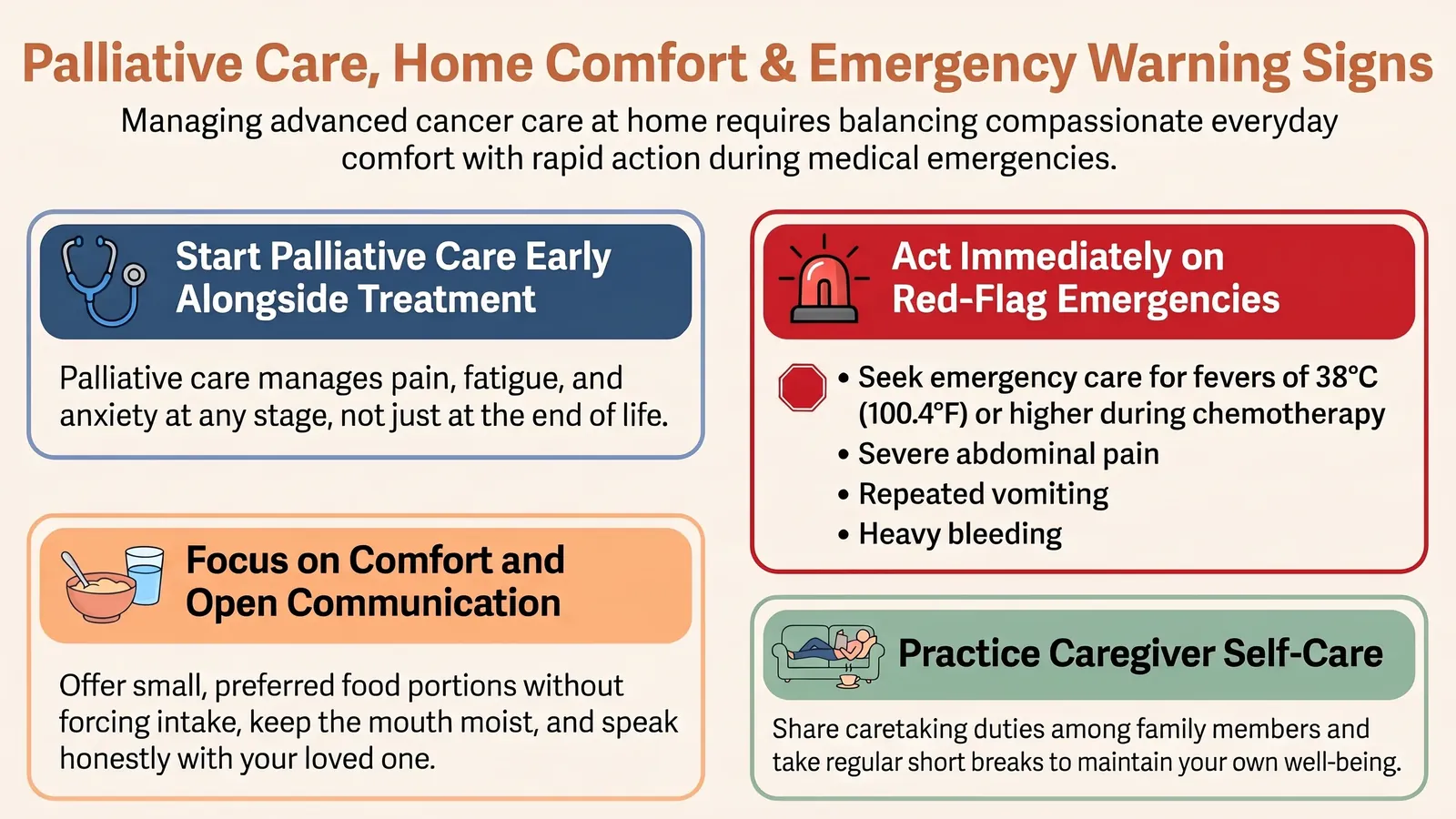
A summary of home comfort, emergency warning signs and caregiver self-care.
Home care, stopping treatment and the caregiver
As advanced disease progresses, a woman may become more tired and sleepy, eat and drink less, need more help with daily tasks, feel sick or short of breath, or become confused. Sudden confusion can come from infection, dehydration or a medicine effect, so check it promptly. Many symptoms can be eased.
Do not force food or fluids. Offer small amounts she wants, keep her mouth clean and moist, and ask the palliative team how to manage dry mouth, nausea and pain. Oxygen, drips and feeding tubes are decided individually, based on her symptoms, condition and goals.
Some women decide that they no longer want chemotherapy or another major treatment, after repeated admissions, severe side effects, limited benefit, or a wish to be at home. First understand why. Some problems, such as pain that is not controlled or fear of side effects, can be fixed. If she can make her own decisions, her choice should be respected, and the team should offer a support plan either way. Stopping anticancer treatment is not stopping care.
Caring for someone with advanced cancer is exhausting. Share the work among relatives, accept help, take short breaks, and ask the palliative team about support for caregivers. If you feel hopeless or cannot cope, talk to the team or your own doctor. Needing help does not mean you are failing her.
Frequently asked questions
Frequently Asked Questions
Is stage 3 ovarian cancer curable?
Some women reach long remission, and others have the cancer return. The outcome depends on how much cancer was removed, the response to chemotherapy, the tumour's biology and general health.
Can stage 4 ovarian cancer be controlled?
Often for a meaningful period, yes. Control may not be permanent, and the plan may need to change as the disease responds.
What is the difference between platinum-sensitive and platinum-resistant ovarian cancer?
Platinum-sensitive means the cancer returned more than six months after platinum treatment and may respond again. Platinum-resistant means it returned within six months or grew during treatment, and usually needs a different approach.
How do doctors know whether treatment is working?
They combine symptoms, CA-125 blood tests over time and scans. A single result rarely decides the plan on its own.
When should palliative care be involved?
Early, alongside active treatment. It can help with symptoms and decisions at any stage, and it does not mean that treatment has stopped.
A diagnosis that treatment is not working is painful. It does not mean that care has ended. If treatment is still working, help her continue it safely. If not, reassess the options with the team, and ask whether a different drug, a targeted treatment or a trial might help. If symptoms are hard to bear, bring in palliative care now, not later. Good cancer care treats the disease and the person living with it.
This article is for general information and does not replace consultation, examination or review of medical records by a qualified doctor. Treatment decisions depend on the exact type, stage, previous treatment, scan and molecular test results, and the patient's overall condition. Availability, approval status and cost of specific medicines should be confirmed with the treating team. In an emergency, seek medical care immediately.
References
- National Cancer Institute, SEER Program. Cancer Stat Facts: Ovarian Cancer (SEER 21, 2015 to 2021). Bethesda, MD: National Cancer Institute.
- Gaillard S, Lacchetti C, Armstrong DK, et al. Neoadjuvant chemotherapy for newly diagnosed, advanced ovarian cancer: ASCO guideline update. J Clin Oncol. 2025;43(7):868–891.
- Vergote I, Tropé CG, Amant F, et al. Neoadjuvant chemotherapy or primary surgery in stage IIIC or IV ovarian cancer. N Engl J Med. 2010;363(10):943–953.
- Lesnock JL, Temin S, Bouberhan S, et al. Systemic treatment of ovarian cancer recurrence: ASCO living guideline, version 2026.1.0. J Clin Oncol. Published online 24 August 2026.
- Moore KN, Angelergues A, Konecny GE, et al. Mirvetuximab soravtansine in FRα-positive, platinum-resistant ovarian cancer. N Engl J Med. 2023;389(23):2162–2174.
- US Food and Drug Administration. FDA approves relacorilant with nab-paclitaxel for platinum-resistant epithelial ovarian, fallopian tube, or primary peritoneal cancer. 25 March 2026.
- Central Drugs Standard Control Organisation, India. Subject Expert Committee (Oncology): recommendations, dated 18 March 2026.
- National Institute for Health and Care Excellence. Mirvetuximab soravtansine for treating folate receptor alpha-positive platinum-resistant epithelial ovarian, fallopian tube or primary peritoneal cancer. Technology appraisal guidance TA1169. June 2026.
- World Health Organization. Palliative care: key facts. Fact sheet. Geneva: WHO.
- Ferrell BR, Temel JS, Temin S, et al. Integration of palliative care into standard oncology care: American Society of Clinical Oncology clinical practice guideline update. J Clin Oncol. 2017;35(1):96–112.
Related Reading

Is ovarian cancer treatment no longer working?
Dr. Dipanwita Banerjee offers consultations at CNCI Kolkata to review ovarian cancer treatment and plan the next steps.