Much of the care after a diagnosis happens at home, and the people giving it need clear, practical guidance too.
Gynaecological cancer treatment is more than hospital visits. Between scans, cycles and operations, much of the day-to-day care happens at home, and it is often given by a husband, a son or daughter, a sibling or a close friend. This guide is for those carers. It covers daily routines, food, emotional support and the emergencies that need a call the same day.
What does a carer need to know first?
Keep to the treatment routine and a simple daily record. During chemotherapy, a temperature of 38°C (100.4°F) or higher is an emergency: call the oncology team at once, and do not give paracetamol before you have spoken to them.
You do not need medical training to help at home. The team will explain which symptoms to watch for and which medicines to give, and when. Write their after-hours number down and keep it where everyone can see it. Bring your questions to each visit, and write down the answers.
How do I keep the home routine safe?
Keep a simple daily log of temperature and symptoms, including appetite, vomiting, diarrhoea, pain, bleeding, passing urine and sleep. Bring it to every appointment. Give medicines at the times written on the prescription, using a chart or a phone alarm, so that doses are not missed or doubled.
- Temperature: check it at the same time each day, and whenever she feels hot, shivery or unusually unwell.
- Hand hygiene: wash hands with soap before preparing food, before giving medicines and after using the toilet. Ask visitors with a cough, cold or stomach upset to stay away until they are well.
- Food safety: cook food thoroughly, keep raw and cooked food apart, and do not keep leftovers for long.
What should she eat and drink?
Small, frequent meals with enough protein and energy usually suit people better than three large meals, especially when appetite and taste change. Ask her team to refer her to a dietitian who works in cancer care.
Guidelines from the European Society for Clinical Nutrition and Metabolism recommend that people with cancer are checked for poor nutrition and given individual dietary advice during treatment.[1] In practice, this can mean protein such as dal, eggs, paneer or fish at most meals, with rice, khichdi, oats or other energy-rich foods. Fluids such as buttermilk, clear soups and boiled, cooled water can help, provided that milk products are pasteurised and food is prepared hygienically.
Tell the team about weight loss, poor appetite or difficulty swallowing, rather than managing these only at home. Do not start supplements, herbal remedies or special diets without asking the team first, because some can interact with treatment.
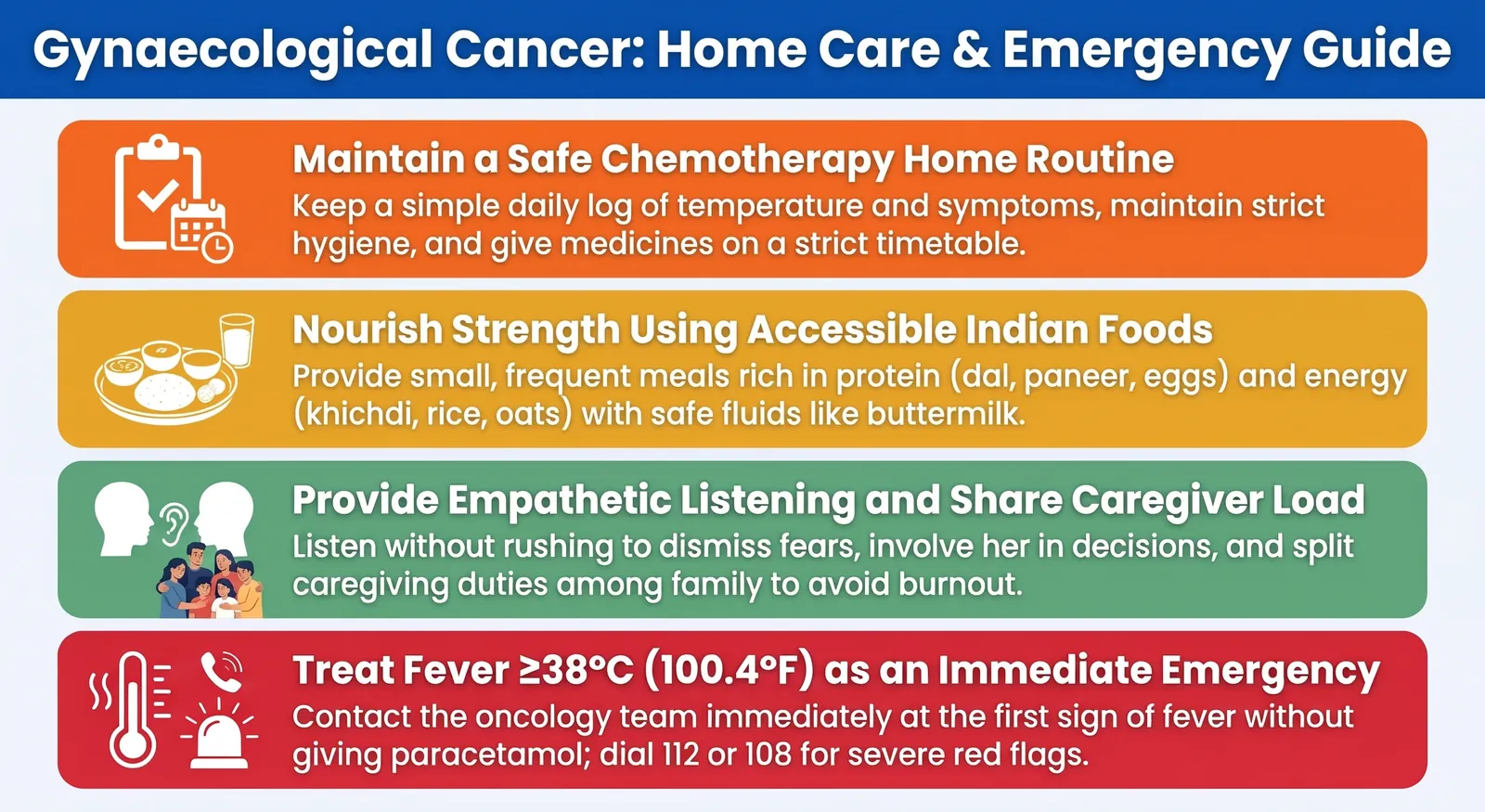
A quick reference for carers: the daily routine, food, emotional support and the fever rule.
How can I support her emotionally?
Fear, anger, guilt and sadness are common during treatment. Listening without rushing to reassure her or fix the problem often helps more than advice. Ask what she wants to know, and how much detail she wants at each stage. Involve her in decisions where she is able to take part, because feeling in control can ease anxiety.
Caring is tiring, and carers can feel exhausted, irritable or low too. Share the tasks among family members, agree who will take hospital visits or night-time duties, and take a break when you can. If you are not sleeping, feel hopeless or cannot cope, speak to your own doctor or a counsellor. Looking after yourself is part of looking after her.
When is it an emergency?
During chemotherapy, a temperature of 38°C (100.4°F) or above needs an immediate call to the oncology team, day or night. Do not wait for the next appointment, and do not give paracetamol before speaking to the team.
Chemotherapy can lower the white blood cells that fight infection. When this happens, an infection can become serious quickly, and fever may be the only early sign.[2] Paracetamol can lower a temperature and hide a fever, so the team needs to know the reading before anything is given.
Call the team straight away, too, if she has:
- chills or shaking, even without a measured fever
- a new cough, sore throat or burning when passing urine
- diarrhoea or vomiting that stops her keeping fluids down
- redness, pain or discharge around a port, drain, wound or cannula
- unusual drowsiness or confusion
For severe signs, such as trouble breathing, chest pain, fainting, a fit or heavy bleeding, call 112 (the national emergency number) or 108 (ambulance), and tell the oncology team as soon as you can.
"If you are unsure whether something is an emergency, call. A call that turns out to be unneeded causes far less harm than a delay."
Where can the family get practical help?
Keep reports, scan results and a list of medicines in one folder, and bring it to every visit. Our guide on changing hospital during cancer treatment explains what to bring if care moves to another centre. For planning costs, cancer treatment costs in Kolkata and financial help covers what families can expect. Ask the hospital help desk whether government schemes such as Ayushman Bharat or West Bengal's Swasthya Sathi apply, because they may cover part of care in empanelled hospitals.
Frequently Asked Questions
Do I need medical training to care for someone at home?
No. The team will show you which symptoms to watch for, how to give medicines and when to call. Ask them to show you, and write the instructions down.
What temperature counts as a fever during chemotherapy?
A temperature of 38°C (100.4°F) or higher is treated as an emergency. Check it with the same thermometer each time, and call the team straight away.
Can I give paracetamol if she has a fever?
Not before you have spoken to her oncology team. Paracetamol can lower a temperature and hide the signs the team needs to see. Ask them what to do first.
Are there foods I should avoid?
Ask her team or a dietitian. In general, eat freshly cooked food, use pasteurised milk products, and avoid raw or undercooked food. Do not start supplements or special diets without advice.
References
- Arends J, Bachmann P, Baracos V, et al. ESPEN guidelines on nutrition in cancer patients. Clinical Nutrition, 2017;36(1):11–48.
- Taplitz RA, Kennedy EB, Bow EJ, et al. Outpatient management of fever and neutropenia in adults treated for malignancy: ASCO and IDSA clinical practice guideline update. Journal of Clinical Oncology, 2018;36(14):1443–1453.
Related Reading

Caring for someone through treatment and worried about a symptom?
Dr. Dipanwita Banerjee offers consultations at CNCI Kolkata, where patients and their families can talk through a home care plan and the warning signs to watch for.