
Most families who walk into a cancer clinic for the first time are carrying a file, a few reports in a plastic cover, and a lot of questions they have not yet found words for. Within a few weeks, that file may have grown thick with new reports from different laboratories, a letter from a surgeon, a second opinion from another city, and discharge summaries from more than one hospital.
This article is for the people in that situation. It is for the patient who wants to be sure they are receiving appropriate treatment, the son or daughter who has taken leave from work to accompany a parent, and the doctor who receives a patient halfway through another team's treatment plan.
The central message is simple: changing doctors or hospitals can be the right decision. What matters is not losing the thread of care.
Cancer treatment is a sequence of clinical decisions. Each decision depends, in part, on what has happened before it. When medical records, treatment dates and the reasons for previous decisions do not travel with the patient, the next team may have to reconstruct the clinical history before deciding what should happen next.
That can create avoidable uncertainty and, in some circumstances, delay.
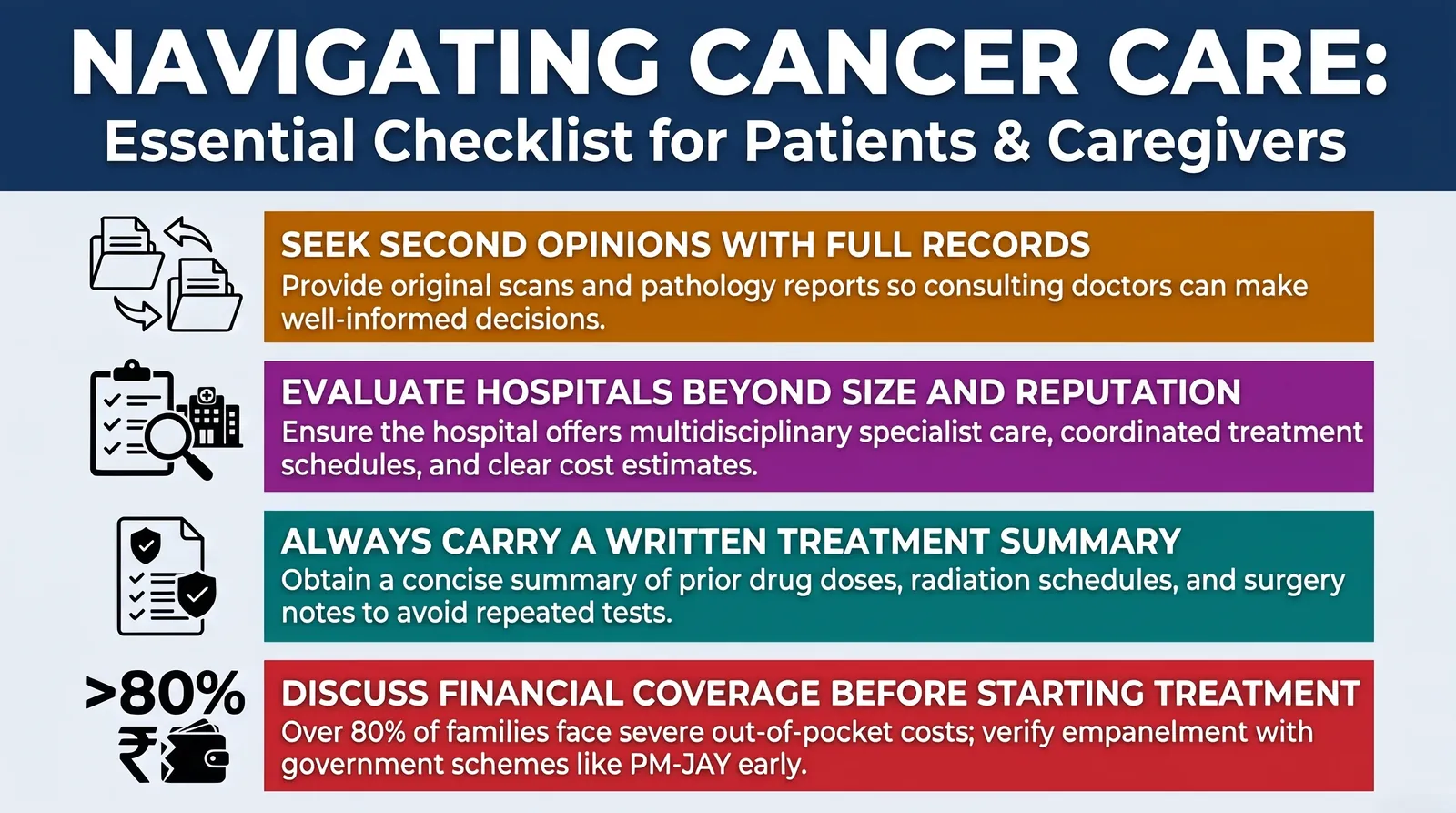
Four practical steps for patients and caregivers: complete records, the right hospital fit, a written treatment summary and an early financial plan.
Why the thread matters
Cancer treatment is a sequence of clinical decisions, and each one depends on what has already happened. When the records and the reasons behind earlier decisions are missing, the next step can be delayed even though nobody has done anything wrong.
A cancer treatment plan is shaped by the type of cancer, its stage, the histopathology, imaging findings, the patient's general health and the treatment already received.
Chemotherapy is often administered in cycles, with intervals determined by the particular regimen and the patient's recovery. Radiotherapy is planned as a course of sessions. Surgery may be timed before or after other treatment. In some cancers, the sequence of surgery, chemotherapy and radiotherapy is an important part of the overall plan.
When one step changes, the subsequent steps may also need to be reconsidered.
Some delays are unavoidable and may even be safer than proceeding as originally planned. A patient with a serious infection, inadequate blood counts or significant treatment-related toxicity may need a postponement or modification. The decision depends on the clinical circumstances.
However, avoidable delays can also occur: a missing pathology report, an unclear handover, unavailable imaging, uncertainty about the chemotherapy already administered, or a repeated investigation because the original result cannot be accessed.
What does the evidence say about treatment delays?
A 2020 systematic review and meta-analysis published in the BMJ examined 34 studies involving approximately 1.27 million patients across 17 cancer treatment indications. It found an association between each four-week delay and increased mortality in 13 of the 17 indications studied. The findings varied according to cancer type and treatment modality. The authors analysed observational evidence; the results do not mean that every delay causes harm in every individual patient.[1]
A 2007 review examined the effect of unplanned radiotherapy interruptions across different tumour sites. It discussed the importance of overall treatment time, particularly in head and neck cancers. These findings should not be applied indiscriminately to every cancer or radiotherapy schedule.[2]
The evidence is not uniform across all cancers. A 2026 meta-analysis of lung cancer studies did not find a statistically significant association between treatment delays of four, eight or twelve weeks and overall survival. However, the studies were highly heterogeneous, and the analysis cannot establish that such delays are safe for an individual patient.[3]
The practical conclusion is not that every treatment delay is dangerous, or that treatment should proceed regardless of a patient's condition. It is that the timing of treatment should be planned and reviewed by the treating team, and avoidable delays should be minimised.
A second opinion is not a betrayal
A second opinion can help when the diagnosis or stage is uncertain, when major surgery is proposed, when several reasonable options exist, or when the risks and benefits have not been explained clearly enough.
In India, some families hesitate to ask for a second opinion. They may worry that it will offend the first doctor or create confusion. Neither concern should prevent a patient from seeking clarification.
A second opinion can be useful when:
- The diagnosis or stage is uncertain.
- The proposed treatment involves major surgery or a complex procedure.
- There are several reasonable treatment options.
- The expected benefits and risks have not been adequately explained.
- The patient has concerns about the proposed plan.
- Specialist expertise or facilities available at another centre may be relevant.
A second opinion does not automatically mean that the first doctor was wrong. Cancer care involves clinical judgement, and more than one treatment approach may be reasonable in particular circumstances.
Research illustrates why an independent review can sometimes be valuable. In one study of 340 patients seeking a pathology second opinion for breast cancer, 80% had some change in pathological or prognostic information, although a major change affecting surgical treatment occurred in 7.8% of cases.[4]
In another study, 70 breast cancer patients were referred to a US specialist centre for a second opinion. After multidisciplinary tumour board review and further workup, 42.8% had a change in diagnosis. The changes included additional biopsies and newly identified cancers, not only a different reading of the original reports.[5]
These were selected groups of breast cancer patients referred for specialist review, and both studies were retrospective. Their results should not be interpreted as the frequency of diagnostic changes expected among all cancer patients.
A second opinion works best when the new doctor has the complete picture: the original pathology material when required, scans as images rather than only written reports, and a clear account of the treatment already received.
It should ideally lead to a decision that the patient understands and a clear plan for the next stage of care.
The difficulty arises when patients collect multiple opinions from different doctors, each reviewing only part of the clinical history, without anyone reconciling the recommendations.
The purpose of a second opinion is to support a better-informed decision, not to create an endless cycle of consultations without a coordinated plan.
Choosing a hospital: beyond visibility and reputation
The most suitable institution is not necessarily the most expensive, the most heavily advertised or the largest. It is the institution that can provide appropriate care for the patient's clinical needs, within a workable timeframe and with adequate coordination.
A hospital's reputation, infrastructure and visibility may influence a family's choice. However, these features alone cannot establish whether a particular institution is appropriate for an individual patient's cancer and treatment requirements.
A few practical questions can help:
- Does this centre regularly manage my type of cancer?
- Are the relevant specialists available, including surgical, medical and radiation oncologists, pathologists and radiologists?
- Is multidisciplinary review or tumour board discussion available when needed?
- If I need surgery, chemotherapy and radiotherapy in sequence, can these treatments be coordinated?
- How long is the likely wait for consultation, investigations and treatment?
- What is the expected overall cost, including medicines, scans, hospitalisation and travel?
- Which costs are covered by insurance or a government scheme, and which may have to be paid separately?
- Whom should I contact if I develop a complication or cannot attend a scheduled treatment session?
Asking these questions is reasonable. Patients and families should be encouraged to understand the treatment pathway before making a decision.
When treatment moves from one hospital to another
Moving is not a failure. A referral to a centre better suited to the patient's needs can be exactly the right decision. The risk lies in the handover, which is sometimes less complete than families realise.
People change hospitals for many reasons. The cost may become difficult to sustain. Insurance coverage may be exhausted or may not include every component of treatment. A specialised service may be available elsewhere. The family may move closer to relatives who can help with daily care. A second opinion may lead to a different recommendation.
Consider an illustrative situation, not a real patient case. A patient has undergone surgery at one hospital, received four cycles of chemotherapy at another centre, and now wishes to start radiotherapy in Kolkata.
The new team needs to know more than the fact that four cycles of chemotherapy were given. It may need the names of the drugs, doses, dates, any dose reductions, treatment-related complications and the reason for any changes to the original schedule.
Without these details, the receiving team may need to verify the treatment history, obtain missing records or repeat selected investigations before deciding on the next step. This may delay treatment.
A few practical steps can make the transition more efficient. Before leaving the current hospital, ask for:
- Pathology and cytology reports, including slides or paraffin blocks if the new team may need to review them.
- Imaging reports and the actual scans, preferably in their original digital format.
- Blood investigations, including relevant recent blood counts (what they mean) and kidney and liver function tests.
- Operation notes and discharge summaries.
- A chemotherapy summary: drug names, doses, cycle dates, dose changes and significant side effects.
- A radiotherapy summary: prescribed dose, number of fractions delivered, dates of treatment and any interruptions.
- The current treatment plan, including the reason for any planned change.
- A list of current medicines and relevant allergies.
- A referral letter or treatment summary from the previous treating team, where possible.
Keep copies of important records in one organised folder, whether physical or digital. Carry the original reports and imaging files to the first consultation at the new hospital.
A referral letter should ideally summarise the diagnosis, stage, treatment already administered, significant complications and the reason for referral. With the patient's consent, direct communication between the sending and receiving doctors can clarify details that documents alone may not resolve.
A treatment summary is more useful than a pile of reports
A concise treatment summary should ideally include:
- Confirmed diagnosis and histopathology.
- Stage and relevant disease extent.
- Treatment intent, where established.
- Surgery and other interventions already performed.
- Chemotherapy drugs, doses, dates and modifications.
- Radiotherapy dose, fractions and dates, if applicable.
- Significant complications and treatment-related toxicity.
- Latest assessment of disease status.
- Reason for referral or change in treatment.
- The next recommended intervention and its intended timeframe.
The original reports remain important. A summary does not replace them; it helps the receiving team understand the clinical history efficiently.
Records in the digital age: what ABHA can and cannot do
The Ayushman Bharat Health Account (ABHA) is a 14-digit identifier that can help link health records with the patient's consent. It is not health insurance, and it does not automatically collect every record from every hospital.
Many families have heard of the Ayushman Bharat Health Account, or ABHA.
ABHA is a 14-digit identifier under the Ayushman Bharat Digital Mission (ABDM), run by the National Health Authority. It is intended to link a person's health records across healthcare providers, with the person's consent. It is not health insurance and does not itself determine eligibility for a government healthcare scheme.[6]
Records are shared only through a consent process. According to a summary of official material on ABDM, doctors and healthcare providers can access earlier records only through consent that is revocable and time-bound. Patients can also choose which records to share.[7]
However, ABHA does not automatically collect every medical record from every hospital. Integration varies, older reports may not be digitised, and a hospital may not be able to access records from another institution through ABDM.
For continuity of cancer care, ABHA can be a useful addition to the patient's records. It should not be treated as a replacement for maintaining copies of pathology reports, scans, operation notes, discharge summaries and treatment records.
Patients should ask their hospital whether it participates in ABDM and continue to keep their own copies of important documents.
Government schemes, insurance and the reality of cost
Cost is one of the reasons families may need to reconsider where and how treatment is delivered. Scheme coverage, insurance limits and hospital empanelment should be confirmed in writing before the treatment plan is finalised.
Cancer treatment expenses can include surgery, hospitalisation, medicines, chemotherapy, radiotherapy, investigations, travel, accommodation and loss of income. Insurance and government assistance may cover some components, but not necessarily every expense.
Indian studies have documented substantial financial burden among patients receiving cancer treatment.
The CROCODILE study followed patients with colorectal cancer who had a treatment plan at five tertiary hospitals in India. Among the 202 patients included in the expenditure analysis, 90.1% experienced catastrophic health expenditure, defined in that study as out-of-pocket payments exceeding 25% of annual household income. The median total treatment cost was approximately ₹4.08 lakh.[8]
A longitudinal study of 500 breast cancer patients treated at Tata Memorial Centre, Mumbai, estimated catastrophic health expenditure at 84.2%. About 75% of these patients had some form of reimbursement, but it reduced catastrophic expenditure by only about 14%.[9]
These findings come from specific patient populations and should not be treated as estimates for every cancer patient or every hospital. Actual expenditure varies with the cancer, treatment plan, institution, insurance, government support and other circumstances.
The practical lesson is that the financial plan should be discussed at the beginning of treatment, not only after expenses become difficult to manage.
What about government health schemes?
Patients in India may be eligible for central or state health schemes, depending on their residence, eligibility criteria and the current rules.
- Ayushman Bharat PM-JAY is the national health protection scheme. It provides hospitalisation cover of up to ₹5 lakh per family per year for secondary and tertiary care at empanelled hospitals. Cancer treatment is part of the package list, but coverage depends on the package, the hospital's empanelment and the patient's eligibility.[10]
- West Bengal: The state had run its own scheme, Swasthya Sathi, launched in December 2016. In 2026 the state signed an agreement with the National Health Authority to join PM-JAY. Reports indicate that PM-JAY services began on 16 August 2026, alongside the state's Mukhyamantri Swasthya Bima Yojana for families not covered by PM-JAY. Swasthya Sathi was expected to continue for a transition period and then be merged in phases. The reports differ on some timelines and figures, so the position may still be changing. Confirm your eligibility, your family's status and your hospital's empanelment directly with the scheme's cashless or insurance desk.[11]
- Private health insurance and employer schemes may cover some hospital expenses but can have limits, exclusions, waiting periods, sub-limits or restrictions on outpatient medicines and other services. Ask the insurer to clarify coverage before changing hospitals or beginning a new treatment component.
Where possible, ask the hospital's insurance or scheme desk to confirm in writing:
- Whether the patient is eligible.
- Whether the hospital is currently empanelled for the required treatment.
- Which package applies.
- Whether pre-authorisation is required.
- Which medicines, investigations and procedures are included.
- Whether any additional payment may be required.
Please tell the treating team early if finances are a constraint. Depending on the circumstances, the hospital may be able to guide the family towards a social worker, financial assistance programme, support fund or another appropriate treatment centre.
A treatment plan should be medically appropriate, but it should also be realistic for the patient and family.
For caregivers: the people carrying the file
Much of cancer care in India depends on family members. Someone stands in the registration queue, carries reports, arranges transport, sits at the bedside and remembers medicine timings. Caregivers often carry a considerable responsibility alongside their own work and family commitments.
A few practical habits can help:
- Keep one organised file and one notebook. Record appointments, investigations, medicine changes and instructions given by the doctor.
- Write down questions before each consultation. Ask the most important questions first.
- Ask for the treatment plan in writing when it changes, including the next appointment or intervention.
- Keep emergency contact details accessible. Know whom to call if the patient develops a complication outside normal clinic hours.
- Understand the warning signs relevant to the treatment. Fever during chemotherapy, for example, may require urgent assessment. Follow the specific emergency instructions given by the treating team rather than waiting for the next appointment.
- Look after yourself too. Caregiver fatigue is real. If you cannot manage a scheduled visit or treatment session, inform the hospital and arrange help where possible.
If you are the person making the decision to move to another hospital, you may feel guilty or worry that you are letting the previous team down. That feeling is understandable. However, choosing a different institution for medical, financial or personal reasons is a legitimate decision. The important thing is to communicate the change and preserve the treatment history.
For patients: your right to ask
You do not need to understand every technical term. You do have the right to understand the broad treatment plan and the reasons behind important decisions.
Useful questions include:
- What is the goal of my treatment: cure, control of disease or relief of symptoms?
- What are the planned steps, and why is this sequence recommended?
- When should the next treatment, scan or review take place?
- What could happen if the treatment is postponed?
- Which symptoms should make me contact the hospital urgently?
- If I change hospitals, which records should I bring?
- Who will coordinate my treatment and whom should I contact if there is a problem?
You also have the right to ask for a second opinion, discuss financial limitations and make an informed decision about where you receive care.
Please do not skip, reduce or stop medicines or treatment sessions on your own. If a treatment is difficult to afford, tolerate or attend, tell the treating team. Alternative arrangements may be possible, but the team needs to know about the problem.
For doctors: the handover that protects the patient
Doctors receiving patients midway through treatment often have to make decisions with incomplete information. A few practical steps can make a difference:
- Ask for source documents where necessary. Original pathology reports, slides or blocks, and actual imaging can be important for review.
- Clarify the treatment history. Establish the exact drugs, doses, dates, fractions and procedures already administered.
- Contact the sending team when the history is unclear. Direct communication can resolve ambiguities that may otherwise require repeated investigations or prolonged correspondence.
- Document the reasons for treatment modifications. The next team needs to know not only what was given, but why a cycle was delayed, reduced or omitted.
- Discuss financial constraints openly. A treatment plan that a patient cannot afford to complete may need to be reconsidered. Early discussion can help identify practical alternatives.
- Use multidisciplinary collaboration where appropriate. Complex cases may benefit from review by specialists in surgery, medical oncology, radiation oncology, pathology and radiology.
The National Cancer Grid (NCG), a network of Indian cancer centres coordinated with Tata Memorial Centre, runs Virtual Tumour Boards in which specialists from participating centres discuss complex cases by video. Its use for head and neck cancers has been described in the published literature.[12] The number of participating centres has changed over time, so check the current position with the NCG.
Navya is an online second-opinion service linked with Tata Memorial Centre and the National Cancer Grid.[13] It is a separate service from the NCG Virtual Tumour Board. Patients should check the current service details, eligibility, process and costs directly before using it.
Such networks and services can support clinical collaboration, but they do not replace the responsibility of the treating team to assess the patient and coordinate the next steps.
What continuity really means
Continuity does not mean staying in one hospital at any cost. Patients are free to seek a second opinion, compare centres and move to a centre that can provide the care they need.
It means that every doctor and institution involved understands what has happened so far, what is planned next and who is responsible for the next step.
It means that treatment dates are documented, pathology material and imaging can be accessed, financial constraints are discussed early, and the patient and family know whom to contact.
Cancer is a long journey, often with difficult days in between. The best care is not measured by how many hospitals a patient has visited, or by the reputation of any one institution.
It is measured by whether treatment is appropriate, whether its timing and sequence are carefully considered, and whether the people involved can coordinate care from one stage to the next.
The aim is not to prevent patients from changing doctors or hospitals. It is to make sure that, wherever they go, their treatment journey remains connected.
Frequently Asked Questions
Medical note
This article offers general information about continuity and coordination of cancer care in India. It is not a substitute for individual medical advice. Diagnosis, treatment selection, timing and sequence must be decided by the treating specialists after considering the patient's disease status, previous treatment and overall health.
Government scheme rules, eligibility criteria, packages and hospital networks may change. Patients should confirm current details directly with the relevant scheme and hospital before making financial decisions.
References
- Hanna TP, King WD, Thibodeau S, et al. Mortality due to cancer treatment delay: systematic review and meta-analysis. BMJ. 2020;371:m4087. doi:10.1136/bmj.m4087.
- Bese NS, Hendry J, Jeremic B. Effects of prolongation of overall treatment time due to unplanned interruptions during radiotherapy of different tumor sites and practical methods for compensation. Int J Radiat Oncol Biol Phys. 2007;68(3):654–661. doi:10.1016/j.ijrobp.2007.03.010.
- No detectable impact of short-term treatment delays on lung cancer survival. Geroscience. 2026;48(1):793–805. doi:10.1007/s11357-025-01684-9.
- Staradub VL, Messenger KA, Hao N, Wiley EL, Morrow M. Changes in breast cancer therapy because of pathology second opinions. Ann Surg Oncol. 2002;9(10):982–987.
- Garcia D, Spruill L, Irshad A, Wood J, Kepecs D, Klauber-DeMore N. The value of a second opinion for breast cancer patients referred to a National Cancer Institute-designated cancer center with a multidisciplinary breast tumor board. Ann Surg Oncol. 2018;25(10):2953–2957. doi:10.1245/s10434-018-6599-y.
- Ministry of Health and Family Welfare, Government of India. Lok Sabha unstarred question no. 912, answered 29 November 2024: Ayushman Bharat Health Accounts. Parliamentary reply.
- Drishti IAS, summary of Press Information Bureau material on Ayushman Bharat Health Accounts (consent-based access to records). Summary.
- CROCODILE Study Group. Catastrophic expenditure and treatment attrition in patients seeking comprehensive colorectal cancer treatment in India: a prospective multicentre study. Lancet Reg Health Southeast Asia. 2022;6:100058. doi:10.1016/j.lansea.2022.100058.
- Mohanty SK, Wadasadawala T, Sen S, Maiti S, E J. Catastrophic health expenditure and distress financing of breast cancer treatment in India: evidence from a longitudinal cohort study. Int J Equity Health. 2024;23:145. doi:10.1186/s12939-024-02215-2.
- National Health Authority, Government of India. Ayushman Bharat Pradhan Mantri Jan Arogya Yojana (PM-JAY): package and cover information.
- West Bengal and Ayushman Bharat PM-JAY, 2026. Press reports: AIR News, on the launch of Ayushman Bharat PM-JAY in West Bengal (16 August 2026); Outlook Money, on the rollout from 16 August 2026.
- Virtual Tumor Boards of head and neck cancers at a National Cancer Grid centre: an innovative approach to multidisciplinary care. JCO Global Oncology. 2023;9:e2200348. doi:10.1200/GO.22.00348.
- Navya, an online cancer expert opinion service linked with Tata Memorial Centre and the National Cancer Grid. navya.care.
Related Reading

Need a second opinion or help with a treatment handover?
Dr. Dipanwita Banerjee offers consultations at CNCI Kolkata for gynaecological cancers, including review of existing reports and treatment history.