
Family history matters from both sides of the family. The first step is a conversation with a specialist.
Finding out that ovarian cancer runs in your family can bring fear, guilt and a flood of questions. Who should be tested? What does a BRCA result mean for your daughters? Does a positive result mean surgery? This article answers these questions in plain language. It is general information. Your own decisions should follow an assessment with a genetic counsellor or gynaecological oncologist.
Is ovarian cancer hereditary?
Most ovarian cancers are not inherited. Inherited changes, especially in BRCA1 and BRCA2, account for an important minority. They raise lifetime risk without making cancer certain.
Most of the genetic changes that lead to ovarian cancer develop during a woman's lifetime, not from her parents. Even so, a meaningful share is linked to inherited changes. One multicentre Indian study found that roughly one in five women with epithelial ovarian, fallopian tube or primary peritoneal cancer carried a harmful BRCA1 or BRCA2 change.[1]
Patterns that suggest an inherited cause include:
- Ovarian cancer in a mother, sister, daughter or grandmother
- Two or more relatives with ovarian cancer
- Ovarian and breast cancer in the same woman or the same family
- Breast cancer diagnosed at a young age, or in both breasts
- Male breast cancer, or pancreatic or aggressive prostate cancer in a relative
Include both your mother's and your father's side of the family. Men carry and pass on BRCA changes too.
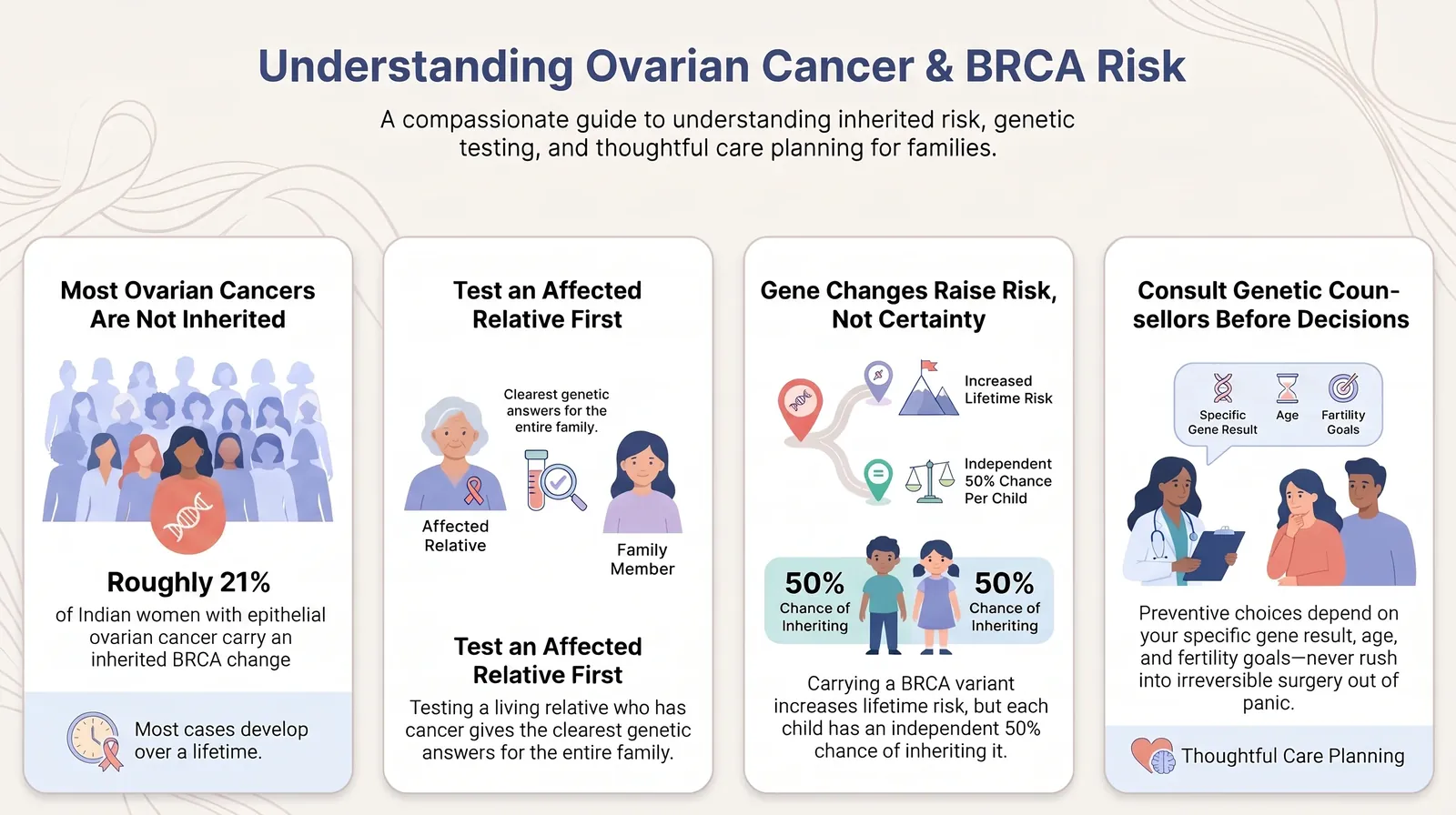
A gene change raises risk, but it does not make cancer certain. Preventive choices depend on the specific result, age and fertility goals.
My mother had ovarian cancer. What should I do?
Your risk is likely higher than average, but it is not automatically high. The next step is to find out what is known about your relative's cancer and whether she was ever tested.
- If your mother is alive, ask her treating doctor whether she has had germline genetic testing. If not, ask whether she can be tested.
- If she has died, collect her pathology report, medical records and any genetic results.
- Write down the cancers on both sides of the family, with ages at diagnosis. Indian expert guidance recommends a history covering three generations.
- Ask your doctor for a referral to a genetic counsellor.
Why testing an affected relative first helps
If a living relative has ovarian cancer, testing her is usually the most informative step. If she carries a specific harmful change, the rest of the family can be tested for that one change only. This is called cascade testing. It gives a clear answer and avoids broad, less precise testing.
A negative result works differently. If no change has been found in the family, a negative result on a broad test does not necessarily rule out inherited risk. A genetic counsellor can explain which situation applies to you.
What do BRCA1 and BRCA2 mean for risk?
BRCA1 and BRCA2 help repair damaged DNA. A harmful change in one copy raises the risk of several cancers, and the size of the risk depends on the gene.
Everyone has two copies of each gene, one from each parent. A harmful change in one copy means the body has less ability to repair DNA damage, so the risk of cancer rises over a lifetime.
In a large international study of BRCA1 and BRCA2 carriers, the estimated ovarian cancer risk by age 80 was about 44% for BRCA1 and about 17% for BRCA2.[2] Breast cancer risk by age 80 was high for both, at about 72% for BRCA1 and about 69% for BRCA2 in the same study. These are group estimates. They do not predict what will happen to any one woman, and your doctor can explain how your family history changes the estimate for you.
Because breast and ovarian risks are separate, prevention for each is a separate decision.
Other genes that matter
Other genes are also linked to ovarian cancer. These include RAD51C, RAD51D and BRIP1. PALB2 is more strongly linked to breast cancer, and its ovarian risk is less established. The Lynch syndrome genes (MLH1, MSH2, MSH6, PMS2 and EPCAM) raise the risk of colorectal, uterine and ovarian cancer.[3]
Evidence and surgical advice differ from gene to gene. A genetic counsellor will recommend either targeted testing for a change already known in the family, or a wider panel when the family history points to more than one gene. A bigger panel is not automatically better. The right test depends on your history and on what the result would change.
Who should get tested?
Every woman diagnosed with epithelial ovarian cancer should be offered germline genetic testing, whatever her family history. Anyone with the family patterns listed above should ask for a genetic counselling referral.
ASCO guidance recommends germline testing for BRCA1, BRCA2 and other ovarian cancer susceptibility genes in all women with epithelial ovarian cancer, regardless of family history. The result can also guide treatment, including PARP inhibitors in suitable cases, and it tells relatives whether they should be tested.[4]
The test uses a blood or saliva sample, and results usually take several weeks. Counselling before and after testing is important. If no genetic counsellor is nearby, tele-consultation may be an option.
Understanding your result
- Harmful or likely harmful change: a higher-than-average lifetime risk. It does not mean you have cancer. The next steps usually include a breast screening plan, a discussion about removing the ovaries and tubes, and testing for eligible relatives.
- No harmful change found: if an affected relative had a known change and you do not carry it, your risk from that change is considered low. If no family change is known, a negative result is less reassuring, and your family history still matters.
- Variant of uncertain significance (VUS): the change has not yet been classified. A VUS should not decide surgery. Ask for periodic review, because some are later reclassified.
Ask your doctor to explain the exact classification in your report before making any irreversible decision. A report that mentions a mutation is not, by itself, a reason for surgery.
What about my daughters and sons?
Each child of a parent with a harmful change has a 50% chance of inheriting it, whether a son or a daughter. Each child's chance is independent of the others.
Testing for adult-onset cancers is generally not recommended for children under 18, because the result rarely changes care in childhood. Once adult, a son or daughter can see a genetic counsellor and be tested for the specific family change. A child who tests negative for that change does not need the related screening or surgery because of it, although other family risks may still need review.
Men with a harmful BRCA change have higher risks of breast, prostate and pancreatic cancer, and they can pass the change to their children. A woman with BRCA-linked ovarian cancer may have inherited the change from her father, which is why both sides of the family matter.
Can preventive surgery reduce risk?
Yes. Removing the ovaries and fallopian tubes greatly lowers the risk of ovarian and tubal cancer in carriers. The timing is a personal decision based on the gene, age and whether childbearing is complete.
The standard operation is risk-reducing bilateral salpingo-oophorectomy, which removes both ovaries and both fallopian tubes. A meta-analysis found that it reduced ovarian and fallopian tube cancer risk in BRCA carriers by about 80%.[5] Some risk remains, because cancer can still start in the lining of the abdomen (primary peritoneal cancer). Surgery reduces risk but does not remove it entirely.
For BRCA1 carriers, timing is commonly discussed at about 35 to 40 years, and for BRCA2 carriers at about 40 to 45 years, once childbearing is complete. Timing for other genes is individual. Removing the ovaries before natural menopause brings surgical menopause, with hot flushes, sleep problems, dryness, mood changes and bone loss. Hormone therapy can relieve many of these, but whether it is suitable depends on your health history, including any history of breast cancer. Discuss it with your gynaecologist before surgery, not only afterwards.
Removing the uterus is not routinely needed only because of a BRCA change.
If surgery is delayed, ultrasound and CA-125 may be discussed, but they cannot prevent cancer and do not replace timely surgery. Report persistent bloating, a growing abdomen, pelvic pain, feeling full quickly or a lasting change in bowel habit, especially if it lasts more than two to three weeks.
Breast screening is a separate decision
Women with a harmful BRCA change are generally offered a breast screening plan that starts earlier than for the general population, usually including MRI and mammography under specialist supervision. Risk-reducing mastectomy is an option for some women, but not every carrier needs it. Your breast specialist will individualise the plan.
What to do next
- Write down the cancer history on both sides, with ages at diagnosis.
- Ask whether any affected relative has had genetic testing.
- See a gynaecologist or genetic counsellor for a hereditary cancer assessment.
- If a harmful change is found, discuss testing for eligible relatives and a plan for surveillance and risk reduction.
- Decide on surgery only after you understand its benefits, its limits and its effect on your health.
Frequently Asked Questions
If my mother had ovarian cancer, will I get it?
No. Your risk is likely higher than average, but most women with an affected mother never develop ovarian cancer. A genetic counsellor can help you understand your own risk.
If my test is negative, can I ignore my family history?
Not always. A negative result for a known family change is reassuring for that change. If no family change was ever found, the result may not rule out inherited risk.
If I have a BRCA change, will my daughters have it?
Each daughter has a 50% chance. It is not certain, and each child's chance is separate.
Does removing the ovaries and tubes prevent all ovarian cancer?
No. It greatly reduces the risk, but a small risk of peritoneal cancer remains. It also brings menopause, which needs planning.
Should my children be tested when they are young?
Generally no. Testing for adult-onset cancers is usually deferred until adulthood, unless there is a specific medical reason.
References
- Gupta S, et al. Prevalence of BRCA1 and BRCA2 Mutations Among Patients With Ovarian, Primary Peritoneal, and Fallopian Tube Cancer in India. JCO Global Oncology, 2021;7:849–861.
- Kuchenbaecker KB, et al. Risks of Breast, Ovarian, and Contralateral Breast Cancer for BRCA1 and BRCA2 Mutation Carriers. JAMA, 2017;317(23):2402–2416.
- National Comprehensive Cancer Network. NCCN Clinical Practice Guidelines in Oncology: Genetic/Familial High-Risk Assessment: Breast, Ovarian, and Pancreatic. Current version.
- ASCO Guideline: Germline and Somatic Tumor Testing in Epithelial Ovarian Cancer. Journal of Clinical Oncology, 2020;38(11):1222–1245.
- Rebbeck TR, et al. Meta-analysis of risk reduction estimates associated with risk-reducing salpingo-oophorectomy in BRCA1 or BRCA2 mutation carriers. Journal of the National Cancer Institute, 2009;101(2):80–87.
Related Reading

Concerned about family history?
Dr. Dipanwita Banerjee offers consultations at CNCI Kolkata for ovarian cancer and hereditary risk assessment.