A stage 3 or 4 diagnosis deserves a clear, unhurried conversation with your treating team.
A diagnosis of stage 3 or stage 4 ovarian cancer raises urgent questions. Can it be cured? How much time is there? Why is the CA-125 blood test going up or down? What are PARP inhibitors, and are they for everyone? This article answers these questions in plain language. It cannot replace a consultation, because each woman's outlook depends on her own pathology, surgery, response to treatment and test results.
Is stage 3 ovarian cancer curable?
Sometimes. Some women with stage 3 disease have long remissions, and some stay free of detectable disease for many years. Recurrence is common, so no team can promise a permanent cure to every patient.
Stage 3 covers a wide range of disease. The outlook depends mainly on:
- Surgery: whether all visible cancer could be removed.
- Chemotherapy response: whether the cancer shrank, stayed stable or kept growing.
- Tumour biology: the subtype, the grade and the BRCA and HRD test results.
- Later treatment: whether a maintenance medicine is suitable and accessible.
Stage 3C is more extensive than stage 3A or 3B, but it can still respond well. Long remission is possible in selected women, particularly when surgery removes all visible disease and the cancer responds to chemotherapy. The risk of return is real, and it should be discussed openly.
What do stage 3 and stage 4 mean?
The stage describes how far the cancer has spread. For ovarian, fallopian tube and primary peritoneal cancers, doctors use the FIGO system.[1]
- Stage 3: the cancer is in one or both ovaries and has spread within the abdomen, to the lining of the abdomen outside the pelvis, and/or to lymph nodes behind the abdominal lining. In stage 3B the visible deposits outside the pelvis are no bigger than 2 cm. In stage 3C they are bigger than 2 cm, and/or the cancer has reached the outer surface of the liver or spleen.
- Stage 4: the cancer has spread beyond the abdomen. In stage 4A, fluid around the lung contains cancer cells. In stage 4B, the cancer has spread into liver or spleen tissue, into organs outside the abdomen, or into lymph nodes outside the abdomen.
The stage can be refined after surgery, once the surgeon and pathologist have examined the tissue.
Is stage 4 ovarian cancer curable?
A permanent cure is uncommon in stage 4 disease. The aim is usually to control the cancer for as long as possible, ease symptoms and protect quality of life.
Stage 4 is not hopeless. Many women respond to chemotherapy, and in some the tumour shrinks substantially. Some have surgery as part of treatment. Maintenance medicines can delay progression in eligible women, and if the cancer returns, further treatment is often possible.
"Control" means the cancer is responding, or staying stable enough to live with well. It can show up as smaller deposits, less fluid in the abdomen or chest, fewer symptoms, a falling CA-125 where it was raised before treatment, or scans that show stable disease. Control is not the same as cure, but for many women it means a period of good-quality life that matters a great deal.
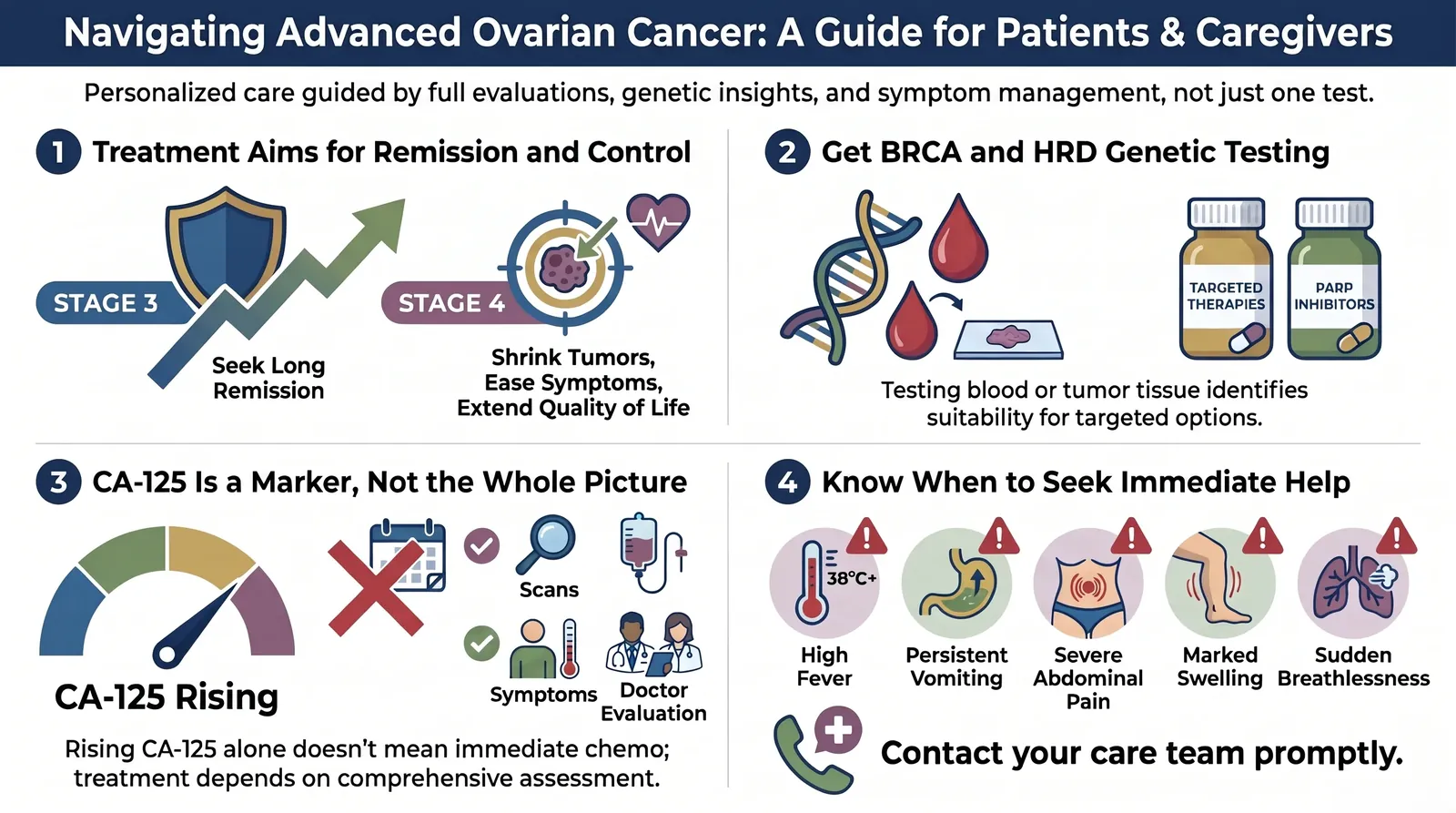
Treatment aims for remission and control. Genetic testing guides targeted options. CA-125 is one piece of the picture, read together with symptoms and scans.
How long can someone live?
Nobody can predict an individual's survival from the stage alone. Survival figures describe groups of past patients, and two women with the same stage can have very different outcomes.
A "median survival" tells you that half of a group lived longer than that time and half lived for less. It is not a personal deadline. Treatment has changed over the years, particularly maintenance treatment and treatment at recurrence, so older figures do not always reflect what is possible today.
Your own outlook is worked out from your pathology report, stage, surgical findings, response to chemotherapy, scan results, CA-125 trend and molecular test results together. These are the details your gynaecological oncology team can discuss with you.
What does a rising CA-125 mean?
CA-125 is a blood marker. A rising value can be an early sign that the cancer is returning, but it does not mean that chemotherapy must start that same day.
CA-125 can rise for reasons other than cancer, such as inflammation or fluid in the abdomen or chest. It can also stay normal when a cancer returns. That is why a single value is never read alone. The team looks at the trend, the symptoms, the examination and the imaging together.
A randomised trial, the MRC OV05 trial, tested this question directly.[2] Women in remission whose CA-125 had risen, but who had no symptoms and no scan evidence of cancer, were assigned either to start chemotherapy straight away or to wait until symptoms or scans showed relapse. Starting early did not improve survival, and it reduced quality of life.
"A rising CA-125 is a reason to look closely, not a reason to panic."
After a rise, your oncologist may repeat the test, ask about new symptoms, examine you, arrange a CT scan and discuss the timing of any treatment. For a woman who feels well and has no clinically significant disease needing treatment, watching closely can be a reasonable choice. That decision is made together, with the woman, not for her.
What are platinum-sensitive and platinum-resistant cancers?
These terms describe how soon after the last platinum chemotherapy the cancer came back. They help guide the choice of the next treatment.
- Platinum-sensitive: the cancer returns more than six months after the last platinum treatment. It often responds to platinum chemotherapy again.
- Platinum-resistant: the cancer returns within six months of the last platinum treatment.
- Platinum-refractory: the cancer keeps growing during platinum treatment, or very soon after starting it.
The six-month line is a convention used in practice, not a sudden change in the biology of the disease. Your team also weighs your previous response, your side effects, any earlier PARP inhibitor use and the pattern of the new disease.
Why genetic testing matters
Women with epithelial ovarian cancer are generally advised to have BRCA testing, and their tumour is usually tested for HRD. Both results can change treatment.
Germline (inherited) testing is done on blood or saliva. It shows whether an inherited BRCA change is present, which also matters for daughters, sisters and other relatives. Tumour testing looks at the cancer tissue itself. A tumour can carry a BRCA change even when the inherited test is negative, so both tests are useful.[3][4]
HRD stands for homologous recombination deficiency, a fault in the way a tumour repairs its DNA. Tumours with HRD may respond to platinum chemotherapy and to PARP inhibitors. A negative HRD result does not mean the cancer is harmless. It means this particular test did not detect the fault, and different HRD tests do not always agree.
A BRCA change can be present even when there is no known family history, so a small or unknown family history does not rule it out. Genetic counselling before and after testing is helpful.
What are PARP inhibitors?
PARP inhibitors are tablets taken by mouth, such as olaparib, niraparib and rucaparib. They are used mainly as maintenance treatment after a response to platinum chemotherapy, in women selected by their BRCA and HRD results and treatment history.
PARP proteins help cells repair certain DNA damage. A cancer cell that already has a fault in another repair pathway, particularly one involving BRCA1 or BRCA2, depends heavily on PARP. Blocking PARP can then leave that cell unable to repair itself. This is called synthetic lethality.
PARP inhibitors are not a replacement for chemotherapy when the cancer is actively growing, and taking one does not mean the cancer has been cured. They are given to delay the return of the disease.
- Common side effects: low blood counts, nausea, tiredness, diarrhoea or constipation, and headache.
- Rare but serious: a disorder of the bone marrow (myelodysplastic syndrome) or acute leukaemia. This risk is weighed in every decision, and regular blood tests are essential.
Do not stop, restart or change the dose of a PARP inhibitor without speaking to your oncologist. Whether one suits you depends on your test results, your response to platinum, earlier treatments, blood counts and kidney function. Which medicines are available, approved and affordable in India should be checked with your team, because indications and access change over time.
If the cancer comes back
Recurrence does not mean treatment has run out. Many women can receive further treatment, and the options depend on how long the cancer stayed in remission, what treatment was given before, and the woman's general health.
Options can include further platinum-based or non-platinum chemotherapy, targeted treatments such as bevacizumab, newer medicines where they are available, clinical trials and, in selected women, a further operation.[5] Surgery again is considered only in selected women, usually when the cancer appears completely removable and the patient is fit for a major operation. It is decided after review by an experienced gynaecological oncology team.
Palliative and supportive care is not the same as stopping treatment. It can be given alongside cancer treatment and helps with pain, nausea, appetite, bowel symptoms, fluid, fatigue, sleep and emotional stress. When further treatment is unlikely to help, or its side effects are likely to outweigh the benefit, comfort and quality of life become the main priority.
Questions to ask your gynaecological oncologist
- What is the exact subtype and stage of my cancer?
- Is the goal cure, long-term remission or control of the disease?
- Is the cancer responding to treatment, judged from the scans and the CA-125 together?
- Is this platinum-sensitive, platinum-resistant or platinum-refractory disease?
- Have my BRCA and HRD tests been done, and what do they show?
- Am I a suitable candidate for maintenance treatment, and what benefit is expected?
- Is surgery a reasonable option, and are there suitable clinical trials?
- What are the side effects and costs, and what does my treatment cover?
Bring pathology reports, operation notes, chemotherapy records, CA-125 results and scan reports, especially if you are seeking a second opinion.
When to seek urgent help
Contact your treating team promptly if you have any of the following:
- A fever of 38°C or higher during chemotherapy, or the threshold your centre has given you.
- Severe or worsening abdominal pain.
- Vomiting that does not stop, or being unable to keep fluids down.
- Marked abdominal swelling with no passage of wind or stool.
- New or worsening breathlessness, or a painful, swollen leg.
- Heavy vaginal bleeding, confusion, fainting or severe weakness.
Some of these may be an infection, a blocked bowel, a blood clot or a side effect of treatment rather than cancer. All of them need prompt assessment.
A falling CA-125 is encouraging, but it does not prove the cancer has gone. The most useful question is not only "How long will I live?" but "What does the full picture show, and which treatment is most likely to help me now?"
Frequently Asked Questions
Is stage 3 ovarian cancer curable?
Some women achieve long remissions, but recurrence is common enough that a permanent cure cannot be promised. Your team can explain your own outlook.
Can stage 4 ovarian cancer be controlled?
Often, for a meaningful period. Control means the cancer shrinks, stays stable or stops causing symptoms. It is not the same as a cure.
Does a rising CA-125 mean the cancer is back?
Not necessarily. It is a warning sign that needs checking with symptoms and scans. In the MRC OV05 trial, starting chemotherapy on a CA-125 rise alone did not improve survival.
Are PARP inhibitors suitable for everyone?
No. They depend on BRCA and HRD results, response to platinum chemotherapy, previous treatment and general health. Availability and cost should be checked with your team.
Is BRCA testing necessary without a family history?
It is generally advised for women with epithelial ovarian cancer. A mutation can be present without a known family history, and the result can change treatment and advice for relatives.
References
- Prat J, FIGO Committee on Gynecologic Oncology. Staging classification for cancer of the ovary, fallopian tube, and peritoneum. International Journal of Gynaecology and Obstetrics, 2014;124(1):1–5.
- Rustin GJ, van der Burg ME, Griffin CL, et al. Early versus delayed treatment of relapsed ovarian cancer (MRC OV05/EORTC 55955): a randomised trial. The Lancet, 2010;376(9747):1155–1163.
- Gonzalez-Martin A, Harter P, Leary A, et al. Newly diagnosed and relapsed epithelial ovarian carcinoma: ESMO Clinical Practice Guideline. Annals of Oncology, 2023;34(10):833–848.
- National Comprehensive Cancer Network. NCCN Clinical Practice Guidelines in Oncology: Ovarian Cancer including Fallopian Tube Cancer and Primary Peritoneal Cancer. Current version.
- National Cancer Institute. Ovarian Epithelial, Fallopian Tube, and Primary Peritoneal Cancer Treatment (PDQ), Health Professional Version.
Related Reading

Questions about advanced ovarian cancer?
Dr. Dipanwita Banerjee offers consultations at CNCI Kolkata for the evaluation and treatment planning of advanced ovarian cancer.