
Chemotherapy is planned in cycles. Knowing the warning signs, especially fever, matters as much as the medicines themselves.
Chemotherapy is one of the most common treatments for gynaecological cancer, and one of the most worrying. It is a planned course of medicines given in cycles, with rest periods between them. Side effects are real, but most can be prevented or controlled, and you should not have to face them alone. This guide explains why chemotherapy is used, what happens on treatment days, which side effects need prompt action, what to eat, and what CA-125 can and cannot tell you.
Is chemotherapy needed for every gynaecological cancer?
No. Whether chemotherapy is needed depends on the cancer type, its stage and grade, the cell type seen under the microscope, the risk of recurrence, any earlier treatment and your general health.
Chemotherapy may be given after surgery to destroy cancer cells that may remain, before surgery to shrink a tumour, together with radiotherapy for some locally advanced cervical cancers, or to control a cancer that has come back. It is commonly used in advanced epithelial ovarian cancer.[1] For locally advanced cervical cancer (FIGO stage IB3 to IVA), European guidance recommends chemotherapy given with radiotherapy wherever possible.[2] For early-stage disease, surgery may be the main treatment. In endometrial cancer, the need for chemotherapy depends on the stage and risk features.
The most useful question to ask your team is not "does my cancer need chemotherapy?" but "what is the purpose of chemotherapy in my treatment plan?"
How many cycles, and how often?
There is no single number. The plan depends on the cancer, the stage, the medicines and how well you respond and tolerate treatment. Many ovarian cancer regimens use a platinum drug with paclitaxel, given every three weeks, and a full course is often around six cycles.[1]
If chemotherapy is given before surgery, the course is usually split, with some cycles before an operation and the rest after it. Some regimens are given weekly, or on more than one day in each cycle. Your team will give you the exact calendar. Please do not compare your plan with another patient's.
The rest period between cycles is not a sign that treatment has stopped working. It allows blood counts and the lining of the gut to recover.
What happens on a treatment day?
Chemotherapy is usually given in a day-care unit. A typical visit includes:
- Assessment: the team asks about fever, infections, appetite, vomiting, bowel and bladder symptoms, pain and side effects since the last cycle.
- Blood tests: usually a full blood count, and kidney and liver tests when needed.
- Review: the oncologist decides whether treatment can go ahead safely.
- Pre-medication: medicines to prevent nausea, vomiting or allergic reactions.
- Infusion: the drugs go in through a drip, cannula or port. Tell the nurse at once about itching, rash, flushing, breathlessness or chest tightness.
- Discharge: instructions on home medicines, food, warning signs and the next visit.
What are the common side effects?
Chemotherapy targets fast-dividing cells, so some healthy ones, such as hair follicles, blood-forming cells and the gut lining, are also affected. Most side effects are temporary, and many can be prevented or reduced.
- Tiredness and weakness.
- Nausea, vomiting and loss of appetite.
- Hair thinning or hair loss, most often with paclitaxel-based regimens. Hair usually regrows after treatment, sometimes with a different texture or colour.
- Constipation or diarrhoea.
- Mouth ulcers.
- Low white blood cells, which raises the risk of infection.
- Low haemoglobin (anaemia) and low platelets, which can cause tiredness and bleeding. Why this happens and what is done.
- Numbness, tingling or burning in the hands or feet with some medicines.
- Rarely, some platinum drugs can affect hearing. Report any ringing in the ears or change in hearing.
Ask your team about scalp cooling if hair loss worries you. It is not suitable for everyone or every hospital. Medicines to prevent nausea work best when taken as prescribed, before symptoms start, not only after vomiting has begun.
Why do blood counts fall during chemotherapy?
Chemotherapy can also affect the bone marrow, the spongy tissue inside bones that makes blood cells. This can lower three kinds of blood cell: neutrophils, which fight infection; red blood cells, which carry oxygen; and platelets, which help blood clot. Your team checks these with a blood test before each cycle. A low count is a reason to adjust treatment, not a sign that it has failed.
Low neutrophils: infection
Neutrophils are the white blood cells that fight bacteria and fungi. When they are low, which is called neutropenia, an infection can become serious quickly. The warning signs and what to do are explained in Why is fever an emergency? below, so they are not repeated here.
Your blood report may show an absolute neutrophil count (ANC), which is the number of neutrophils in a sample of blood. For some regimens with a high risk of serious neutropenia, your team may recommend a growth-factor injection (G-CSF) to help the bone marrow make neutrophils sooner. Whether it is needed depends on your regimen and your individual risk.[6]
Low haemoglobin: tiredness and breathlessness
Haemoglobin is the protein in red blood cells that carries oxygen around the body. When it falls, your tissues receive less oxygen. This is called anaemia. Anaemia is often linked with tiredness, reduced physical ability and lower quality of life.[7] You may also feel dizzy, get headaches, have a faster heartbeat or look pale.
Breathlessness during chemotherapy has several possible causes, including anaemia, infection, blood clots in the lungs and heart problems. Do not assume that breathlessness is only anaemia. Get it checked, especially if it is new or getting worse.
Seek emergency help if breathlessness is sudden or severe, or comes with chest pain, fainting, confusion or blue lips.
Low platelets: bruising and bleeding
Platelets help blood clot. When they fall, you may bruise or bleed more easily, sometimes without an injury. The National Cancer Institute advises telling your team about these signs:[11]
- Bleeding that does not stop after a few minutes, or bleeding from the mouth, nose or gums, or when vomiting.
- Unusual bruising, or tiny red or purple spots on the skin.
- Red or pink urine, or black or bloody stools.
- Bleeding from the vagina when you are not having a period, or a period that is heavier or lasts longer than usual.
- A bad headache, changes in vision, or feeling confused or very sleepy.
Call your oncology team at once about any new bleeding, even if it looks minor. Go to the emergency department if bleeding is heavy or will not stop, you vomit blood, you pass black or bloody stools, or you have a sudden severe headache or a change in vision. Any fall or blow to the head needs urgent review.
To lower the risk of bleeding while your platelets are low:
- Brush gently with a very soft toothbrush, and use an electric shaver rather than a blade.
- Be careful with sharp objects, and wear shoes indoors.
- Check medicine labels for aspirin or ibuprofen, and do not take them unless your team has said they are safe for you.[11]
- Ask your team before starting herbal medicines or supplements, and ask whether you should limit alcohol.[11]
Blood transfusions: when they are used
A blood transfusion gives you red blood cells or platelets from a screened donor through a drip into a vein. It works quickly. For platelets, the rise is usually short-lived and less predictable. Transfusions also carry risks, including transfusion reactions and infection, so it is used when the benefit is clear, not as a routine way of keeping counts high.[10]
For anaemia. For stable adults in hospital, the 2023 AABB international guideline suggests considering a transfusion when haemoglobin falls below 7 g/dL. For adults with haematological or oncological disorders, the recommendation is weaker because it is based on lower-certainty evidence.[8] A slightly higher level, around 8 g/dL, may be considered for some people, such as those with heart disease.[8] In cancer care, ESMO advises transfusion without delay when haemoglobin is below about 7 to 8 g/dL, or at a higher level when severe symptoms need rapid correction.[7] Transfusion is generally reserved for severe symptoms or a need for rapid improvement, so tiredness that is mild is often managed by treating its cause.[7]
Iron and other causes. Before deciding, your team may check your iron stores and vitamin levels. ESMO recommends giving iron through a vein when tests show iron deficiency, so iron tablets should not be started on your own without tests.[7]
For platelets. The ISTH guidance (2024) recommends a precautionary platelet transfusion when the count falls below 10 × 10⁹ per litre. It suggests transfusion for serious bleeding when the count is below 50 × 10⁹ per litre. It recommends against giving platelets just to keep the count high enough for a full-dose cycle.[10] ASCO guidance (2018) uses the same 10 × 10⁹ per litre threshold for solid tumours, and advises higher counts when there is active bleeding.[9] Not every low count needs a transfusion. Your doctor decides using the number, the speed of the fall, any bleeding and your overall condition.
Some newer medicines that raise platelet counts are being studied for chemotherapy-related low platelets. None is approved for this use, so ISTH suggests enrolling in a clinical trial where possible.[10]
What your team checks before each cycle
Your team checks your blood counts before each cycle, usually with a full blood count (CBC). They may also check kidney and liver function, depending on your medicines. The results are compared with the requirements of your particular regimen, and the decision is made with your symptoms, your recovery from the last cycle and your overall health in mind.
Why a cycle may be delayed
If counts have not recovered, your team may delay the next cycle, repeat the blood test, change the dose or schedule, or arrange a transfusion. A delay is a safety decision. There is no single count that applies to everyone. Many protocols use a platelet count of about 100 × 10⁹ per litre as a point to consider a delay or dose reduction, but the exact requirement depends on your drugs, your schedule and your history.[10] Please do not compare your report with another patient's, because the same count can mean different things on different regimens.
"Low blood counts are a known side effect of chemotherapy, and most can be monitored and managed. Report bleeding, worsening breathlessness or severe weakness promptly."
Useful questions to ask your team:
- What were my blood counts, and what do they need to be before my next cycle?
- Do I need a transfusion, a growth-factor injection or iron, and why?
- What bleeding or breathlessness should make me call you straight away?
Why is fever an emergency?
A temperature of 100.4°F (38°C) or higher during chemotherapy is an emergency. Call your oncology team at once, day or night. Do not wait for your next appointment, and do not treat the fever at home first.
Chemotherapy can lower the neutrophils, the white blood cells that fight infection. This is called neutropenia. When neutrophils are low, an infection can become serious quickly, and fever may be the only early sign.[3] Counts are often lowest in the one to two weeks after a dose, but the timing depends on the drugs, so ask your team when yours are expected to be lowest.
What to do:
- Check your temperature whenever you feel warm, flushed, chilled or unwell.
- If it is 100.4°F (38°C) or higher, call your oncology team immediately. Use the after-hours number at night.
- Tell the hospital or emergency department that you are receiving chemotherapy. Only a blood count can show whether your neutrophils are low.
- Follow the team's instructions about whether to come in.
- Do not take paracetamol, ibuprofen, aspirin or any other fever medicine before speaking to the team, because it can hide an important warning sign.
Also report chills or shaking, a new cough or sore throat, burning on passing urine, diarrhoea or vomiting, redness or discharge around a port, cannula or wound, and unusual drowsiness or confusion, even if no fever has been recorded.
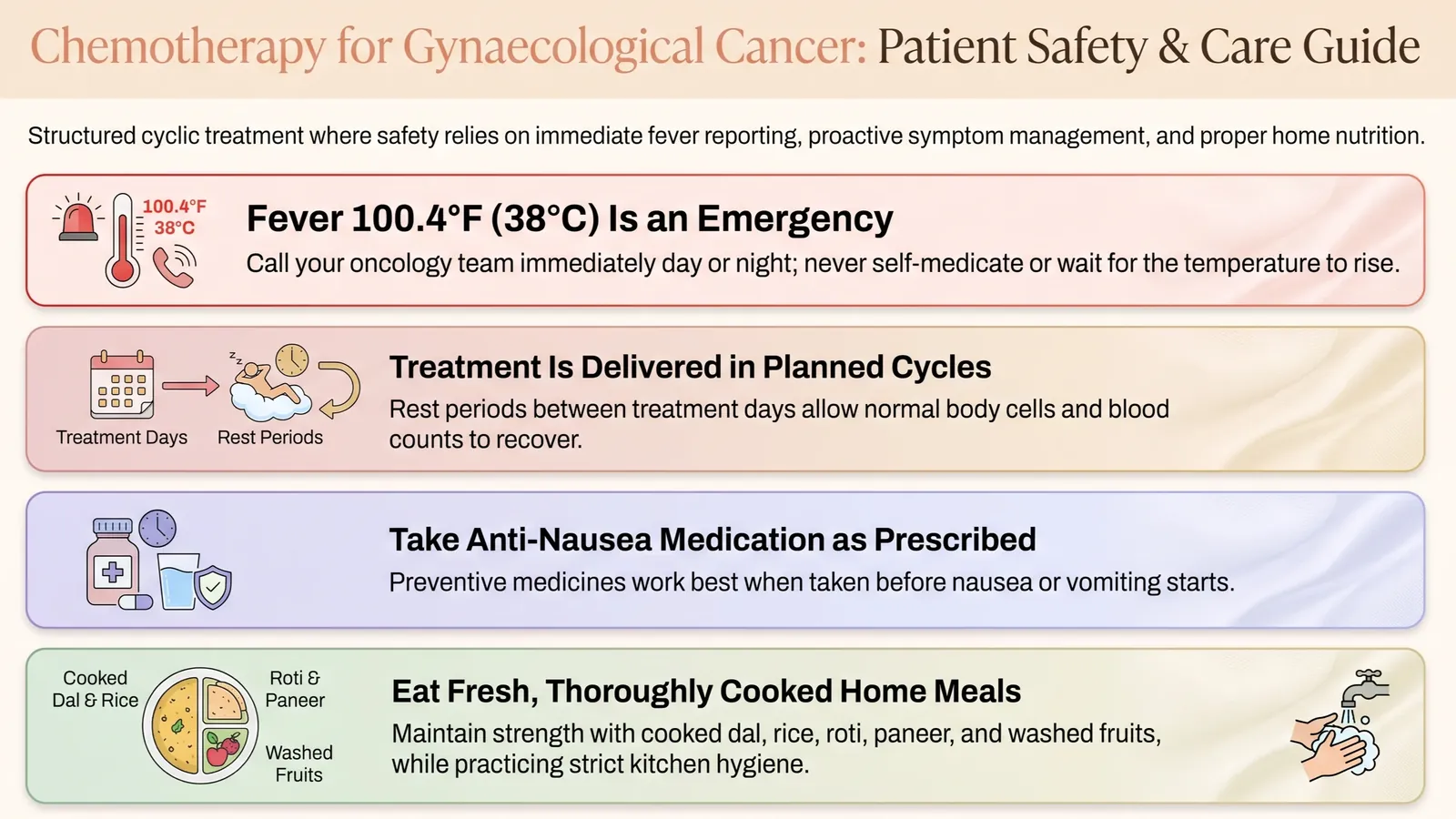
Four safety points: report fever at once, follow the cycle calendar, take anti-nausea medicine as prescribed, and eat fresh, thoroughly cooked food.
"Fever during chemotherapy is never something to manage at home without medical advice."
Urine, bowel and mouth symptoms
Burning on passing urine
Burning, blood in the urine, frequent urination or difficulty passing urine should be reported, not dismissed as a side effect. Possible causes include infection, dehydration and bladder irritation. If burning comes with fever, chills or feeling unwell, seek urgent help. Do not start antibiotics without medical advice.
Diarrhoea
Some medicines irritate the gut. Persistent or severe diarrhoea can cause dehydration and salt imbalance, which can become serious quickly. Call the team the same day if diarrhoea lasts more than a day, stools are much more frequent or watery than usual, you see blood or black stools, you have severe abdominal pain, or you are passing much less urine.
After you have told the team, you may be advised to drink fluids regularly, including oral rehydration solution, to eat small, simple meals, and to avoid alcohol, caffeine and very spicy or oily food. Do not take anti-diarrhoea medicine without checking, especially if you have a fever or blood in the stool.
Constipation and mouth ulcers
Constipation can follow chemotherapy, anti-nausea medicines and painkillers. Fluids, gentle movement and fibre, as your gut tolerates it, help. Seek urgent help if you cannot pass stool or wind with pain or vomiting. Painful mouth ulcers that stop you eating or drinking should be reported the same day.
What should I eat?
Eat as normally as possible, with careful food safety. The aim is to stay nourished, avoid dehydration and keep your strength up. Follow your own hospital's food advice, as it can vary between centres.
A balanced Indian plate can include rice, roti, dalia or khichdi; protein from dal, paneer, curd, eggs, fish or chicken; well-cooked seasonal vegetables; washed and peeled fruit; pasteurised milk and curd; and plenty of fluids your team approves.
- Wash your hands before preparing and eating food.
- Wash fruit and vegetables under clean running water, and peel them where practical.
- Eat freshly prepared food. Avoid anything left out for long or with an unusual smell.
- Use pasteurised milk and dairy. Cook meat, fish and eggs thoroughly.
- Keep kitchen surfaces, utensils and drinking water clean.
Some hospitals advise a strict "neutropenic diet". Current ASCO guidance does not recommend neutropenic diets that exclude raw fruit and vegetables, because there is no clear proof that they prevent infection, and they can make it harder to eat enough.[4] Ask your team how long any food restriction applies. Avoid herbal products, high-dose vitamins and "special cancer diets" unless your oncologist has approved them. There is no reliable evidence that juice cleanses or fasting can replace chemotherapy.
If your appetite is poor, eat small meals more often and include protein at each one. With mouth ulcers, soft, cool, moist foods are often easier. Ask the dietitian whether a nutritional supplement is needed.
Can chemotherapy be delayed or changed?
Yes. This is a safety decision, not a sign that treatment has failed. Cycles are often postponed because counts are low, there is an infection, kidney or liver tests are abnormal, or a side effect needs to settle.
Your oncologist may repeat blood tests, treat the cause and then decide when to restart. The dose, the gap between cycles or the medicines may be changed. Do not skip a cycle, change the date or make up a missed dose yourself. Do not stop treatment because you feel better: the planned course treats cancer cells that cannot be seen or felt. If treatment is hard to manage, say so, because many side effects can be controlled or the plan adjusted.
How do we know it is working?
Your oncologist looks at symptoms, examination, blood tests and imaging together. Side effects do not show whether chemotherapy is working.
CA-125 is a blood protein used as a tumour marker for some ovarian cancers. If it was raised before treatment, a fall can be encouraging. Some teams check it before each cycle, others only at the end.[1] But not every ovarian cancer raises CA-125, a normal result does not rule out cancer, a falling value does not prove that all cancer has gone, and CA-125 can rise for reasons other than cancer. It is read together with symptoms and scans, and it is not a routine response marker for every cervical or endometrial cancer.
When is surgery done relative to chemotherapy?
In advanced ovarian cancer, some women have surgery first and others have chemotherapy first, when surgery is unlikely to remove all visible disease safely, or when immediate major surgery is not suitable.[5]
Women who start with chemotherapy are usually reassessed after a few cycles, and surgery may follow if the disease has responded or is stable. Chemotherapy then continues to complete the course. In cervical cancer, chemotherapy is usually given with radiotherapy rather than followed by routine surgery. In endometrial cancer, many women have surgery first, and chemotherapy may follow depending on the stage and risk.
When to call urgently
Seek immediate help if you have:
- A temperature of 100.4°F (38°C) or higher, or chills or shaking.
- Chest pain, breathlessness or fainting.
- Confusion, unusual drowsiness or severe weakness.
- Vomiting that will not stop, or an inability to keep fluids down.
- Severe or frequent diarrhoea, blood in the stool, or severe abdominal pain.
- Bleeding that will not stop, or blood in vomit.
- Black, tar-like or bloody stools, red or pink urine, or bleeding from the vagina when you are not having a period.
- A sudden severe headache or a change in vision.
- Very little urine, or signs of severe dehydration.
- Redness, swelling, pain or discharge around a port, cannula or wound.
Report these promptly, ideally the same day: mouth ulcers that stop you eating or drinking, new numbness or tingling in the hands or feet, constipation that does not settle, a new rash, changes in hearing, or tiredness that affects daily life. Follow your treatment centre's written emergency advice, as details vary between hospitals.
How caregivers can help
- Keep a record of chemotherapy dates, medicines and appointments.
- Check and note the temperature whenever the patient feels unwell.
- Note food, fluids, urine output and bowel movements when there are concerns.
- Help with medicines taken exactly as prescribed, hand hygiene and safe food preparation.
- Report new symptoms early, and offer support without pressing the patient to eat or to appear cheerful.
Chemotherapy is a planned treatment with specific medicines, doses and monitoring. Some side effects are expected, but you do not need to tolerate every symptom silently. Stay in regular contact with your oncology team throughout treatment.
Frequently Asked Questions
Does everyone lose their hair during chemotherapy?
No. Hair loss depends on the medicines. Paclitaxel-based regimens are more likely to cause it, but some regimens cause little change. Ask your team what to expect for your treatment.
Is fever after chemotherapy normal?
No. A temperature of 100.4°F (38°C) or higher needs an immediate call to your team, because it may mean a serious infection.
Can I eat rice, roti, dal and curd during chemotherapy?
Usually yes, if you tolerate them and they are prepared safely. Use pasteurised dairy and follow your hospital's food advice.
Should I avoid all fruit during chemotherapy?
Not necessarily. Washed and peeled fruit is usually fine, but your team may give more specific advice, especially if your white cell count is very low.
Does a falling CA-125 mean the cancer has gone?
Not necessarily. A falling CA-125 can be encouraging if it was raised before treatment, but it must be read alongside examination and scans.
References
- Gonzalez-Martin A, Harter P, Leary A, et al. Newly diagnosed and relapsed epithelial ovarian carcinoma: ESMO Clinical Practice Guideline. Annals of Oncology. 2023;34(10):833–848.
- Cibula D, et al. ESGO/ESTRO/ESP guidelines for the management of patients with cervical cancer: update 2023. International Journal of Gynecological Cancer. 2023.
- Taplitz RA, Kennedy EB, Bow EJ, et al. Outpatient management of fever and neutropenia in adults treated for malignancy: ASCO and IDSA clinical practice guideline update. Journal of Clinical Oncology. 2018;36(14):1443–1453.
- Ligibel JA, Bohlke K, May AM, et al. Exercise, diet, and weight management during cancer treatment: ASCO guideline. Journal of Clinical Oncology. 2022;40(22):2491–2507.
- Colombo N, Sessa C, du Bois A, et al. ESMO-ESGO consensus conference recommendations on ovarian cancer: pathways to care. Annals of Oncology. 2019;30(5):672–705.
- American Society of Clinical Oncology. WBC Growth Factors: ASCO Guideline Update. J Clin Oncol. 2026;44(9). doi:10.1200/JCO-25-02938. pubmed.ncbi.nlm.nih.gov
- Aapro M, Beguin Y, Bokemeyer C, et al. Management of anaemia and iron deficiency in patients with cancer: ESMO Clinical Practice Guidelines. Ann Oncol. 2018;29(Suppl 4):iv96–iv110. doi:10.1093/annonc/mdx758.
- Carson JL, Stanworth SJ, Guyatt G, et al. Red Blood Cell Transfusion: 2023 AABB International Guidelines. JAMA. 2023;330(19):1892–1902. doi:10.1001/jama.2023.12914.
- Schiffer CA, Bohlke K, Delaney M, et al. Platelet transfusion for patients with cancer: American Society of Clinical Oncology clinical practice guideline update. J Clin Oncol. 2018;36(3):283–299. doi:10.1200/JCO.2017.76.1734.
- Soff G, Leader A, Al-Samkari H, et al. Management of chemotherapy-induced thrombocytopenia: guidance from the ISTH Subcommittee on Hemostasis and Malignancy. J Thromb Haemost. 2024;22(1):53–60. doi:10.1016/j.jtha.2023.09.031.
- National Cancer Institute. Bleeding and Bruising (Thrombocytopenia) and Cancer Treatment. Reviewed December 2022. cancer.gov
Related Reading

Starting chemotherapy and have questions?
Dr. Dipanwita Banerjee offers consultations at CNCI Kolkata to plan gynaecological cancer treatment, including chemotherapy and how to manage its side effects.