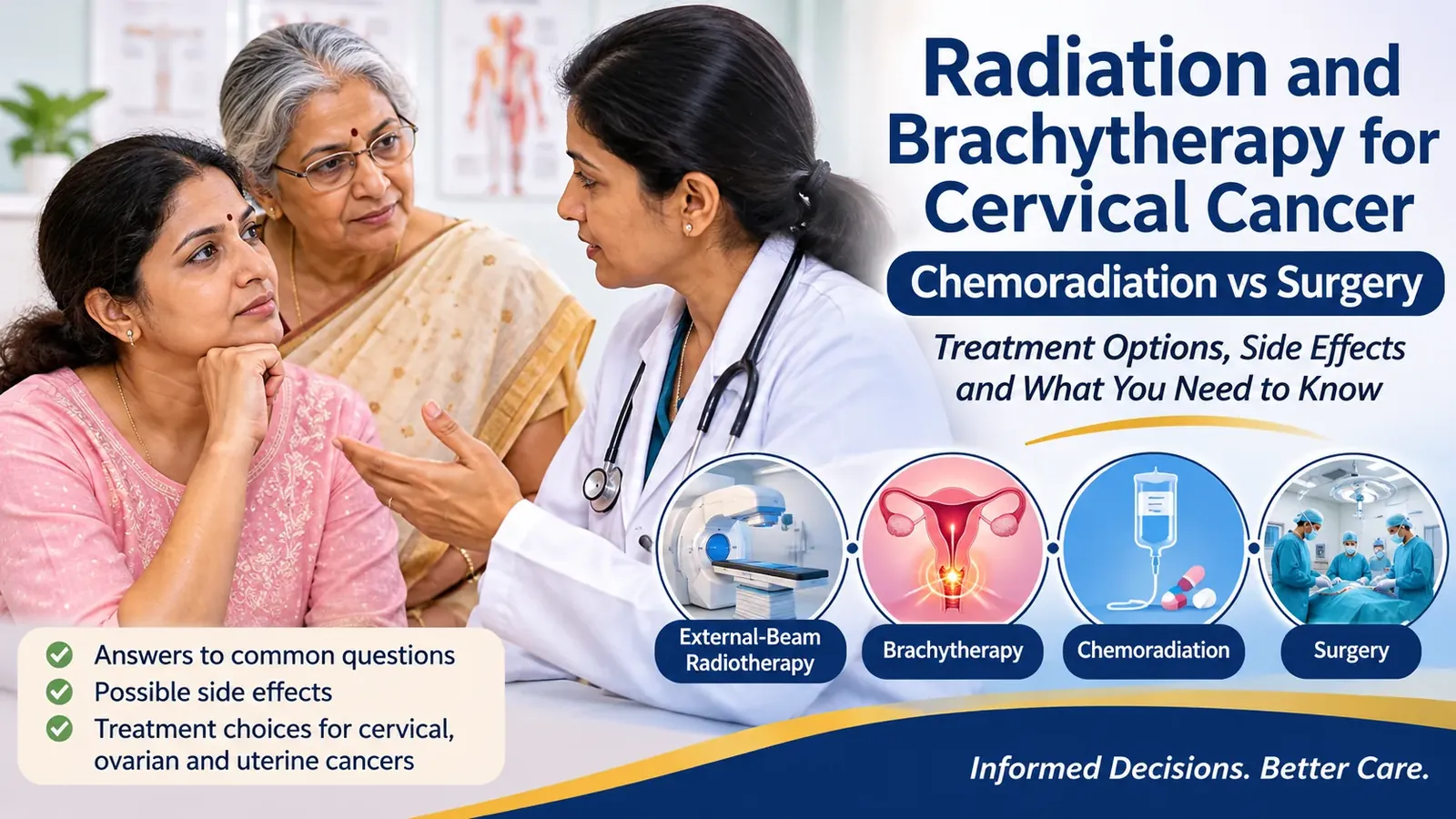
Radiation, brachytherapy, chemoradiation and surgery each have a place. The right choice depends on the stage of the cancer and the findings on scans and biopsy.
A diagnosis of cervical cancer raises many questions. Does every patient need radiation? Is chemotherapy always needed? Is surgery better? Will treatment affect the ability to have children, and how long will side effects last? These are the right questions to ask.
The best treatment depends on how far the disease has spread, the patient's health and the goal of treatment. This guide explains the options in simple terms. It does not replace a consultation with a gynaecological oncologist and a radiation oncologist, who will plan treatment after examining the patient and reviewing scans and biopsy results.
Quick answers
- Does every cervical cancer need radiation? No. Early-stage cancers are often treated with surgery. Larger or more advanced cancers usually need radiation, often with chemotherapy.
- What is brachytherapy? Radiation given from a source placed inside or very close to the tumour for a short time. For locally advanced cervical cancer it is an essential part of curative treatment.
- How many sessions? External radiation is usually 25 to 28 daily sessions over about five weeks. Brachytherapy is usually 3 to 5 sessions. The whole course should ideally finish within about 8 weeks.
- Is chemotherapy given with radiation? Often yes. Weekly cisplatin is the most common drug, when the patient is suitable for it.
- Does radiation affect fertility? Yes. Pelvic radiation usually stops ovarian function and makes pregnancy impossible. Fertility options must be discussed before treatment starts.
Does every cervical cancer need radiation?
No. The choice depends on the stage of the cancer, the size of the tumour, whether it has grown into the tissues beside the cervix (the parametria) or into the bladder or rectum, whether lymph nodes are involved, whether the tumour can be completely removed by surgery, and the patient's general health.
- Very early cancer: cone biopsy or surgery, sometimes with fertility-sparing options.
- Early-stage invasive cancer: surgery (radical hysterectomy) or radiation, depending on tumour size, depth and lymph nodes.
- Larger early-stage tumour, or high-risk features on surgical pathology: often chemoradiation.
- Locally advanced cancer (spread into the parametria or beyond the cervix): chemoradiation with brachytherapy.
- Spread to distant organs: individualised systemic treatment, with radiation for symptoms or selected sites.
These are general patterns, not fixed rules. Staging with MRI, and sometimes PET-CT, is essential. MRI is particularly useful for judging the local extent of the tumour, including parametrial involvement, while PET-CT or other imaging helps check lymph nodes and distant disease.[5]
An important warning: combining radical surgery with pelvic radiation can increase complications. So the likely need for radiation after surgery should be considered before surgery is chosen as the first treatment.
What is external radiation and brachytherapy?
External-beam radiotherapy (EBRT) delivers radiation from a machine outside the body. The treatment itself is painless and takes only a few minutes, though positioning takes longer. Modern techniques such as IMRT and VMAT shape the beam around the tumour to spare nearby organs. The radiation oncologist plans the treatment from a planning scan, marks the tumour and the areas at risk, and the patient lies in the same position each day.
Brachytherapy is internal radiation. A small applicator is placed through the vagina into the uterus and around the cervix, and a radioactive source is moved through it for a planned time, then removed. Patients do not stay radioactive afterwards. Because the source sits close to the cancer, a high dose reaches the tumour while the bladder and rectum receive less. Modern image-guided brachytherapy uses MRI or CT at each session to shape the dose to the tumour's actual position. Applicator placement can be uncomfortable, so it is usually done under anaesthesia or sedation.
For locally advanced cervical cancer, brachytherapy is an essential part of curative treatment. In the EMBRACE-I study of more than 1,300 patients, MRI-guided brachytherapy combined with chemoradiation gave 5-year local control above 90%.[2] Replacing brachytherapy with an external-beam boost is not considered an equivalent standard. If a centre cannot provide brachytherapy, referral to a centre that can should be considered, especially when the goal is cure.
How many sessions, and why must it not be delayed?
- External radiation: usually 25 to 28 daily sessions, five days a week, about 45 to 50.4 Gy in total.
- Weekly chemotherapy (if suitable): usually once a week during external radiation.
- Brachytherapy (HDR): commonly 3 to 5 sessions, depending on the schedule used.
- Overall: ideally finished within about 8 weeks (56 days).
These are typical examples; your team will give you the exact plan for your case. Cervical cancer can grow quickly during treatment, and treatment that runs well beyond 56 days is linked with worse pelvic control.[12] Very strict limits may increase the risk of rectal inflammation, so the team aims for the shortest safe overall time and individualises the plan. Tell your team early about illness, transport or money problems that could cause missed sessions. Many centres can help arrange support.
Is chemotherapy given with radiation?
Often, yes, in locally advanced cervical cancer. This is called concurrent chemoradiation. The most common drug is weekly cisplatin, which makes cancer cells more sensitive to radiation. Carboplatin is sometimes used instead when cisplatin is not suitable. Kidney function, hearing, blood counts and general health are checked first. Chemotherapy adds side effects such as nausea, tiredness and low blood counts, so blood tests are monitored during treatment.
What are the side effects?
Radiation affects cancer cells and some nearby healthy tissue. How much depends on the dose, the area treated, the technique, whether chemotherapy is given, and the patient's general health. Many short-term side effects settle within weeks to months. Others appear months or years later.
- During and soon after treatment: tiredness, diarrhoea or cramps, nausea (more likely with chemotherapy), burning or frequent urination, vaginal irritation or light bleeding, and falling blood counts.
- Longer term (less common): ongoing bowel urgency or bleeding, bladder narrowing or persistent frequency, vaginal dryness and shortening, and rarely a fistula (an abnormal channel).
In the EMBRACE-I long-term study of over 1,200 patients, 5-year rates of severe (grade 3 or higher) problems were about 8.5% for bowel events, 6.8% for bladder and urinary events, 5.7% for vaginal events and 3.2% for fistulas.[3] Counting every category together, about one in four patients (26.6%) had at least one severe event by 5 years. That combined figure does not mean that one in four patients will have severe bowel or bladder damage. Most individual problems were uncommon, and newer MRI-guided planning and careful dose limits have improved these figures. Your team can discuss your own risk.
Report promptly: persistent rectal bleeding, severe abdominal pain, blood in the urine, leakage of urine or stool, or new vaginal discharge after treatment. These should not be assumed to be "just radiation."
Will radiation affect fertility, ovaries or menopause?
Yes. Pelvic radiation usually makes it impossible to conceive afterwards, because it damages the ovaries and the uterus. Two questions are separate: whether the ovaries keep producing hormones and eggs, and whether the uterus can carry a pregnancy. Protecting the ovaries does not answer the second question, because the uterus can still be damaged by radiation.
If the ovaries receive pelvic radiation, hormone production usually stops. Women who have not reached natural menopause may have stopped periods, hot flushes, vaginal dryness, mood changes and reduced desire. Hormone replacement therapy may be suitable for many survivors, but this must be discussed with the oncologist. Non-hormonal options are also available.
Women who wish to have children should discuss fertility before treatment starts. Options depend on the stage and planned treatment: fertility-sparing surgery in carefully selected early-stage cancers, egg or embryo freezing when time allows, ovarian tissue preservation in selected cases, and ovarian transposition, which surgically moves the ovaries away from the radiation field. Transposition has limits. In one systematic review of 1,377 women, ovarian function was preserved in about 62% of the 699 patients who could be assessed for it.[6][7] These figures are not fertility rates, and data on pregnancy after transposition are limited. Transposition does not protect the uterus, and chemotherapy can further reduce ovarian function. Fertility preservation must never compromise the chance of curing the cancer.
Is surgery or radiation better?
Neither is universally better. Surgery is an important option for selected early-stage cancers. It may include cone biopsy for very early disease, simple hysterectomy in selected cases, radical hysterectomy (removal of the uterus, cervix, surrounding tissues and the upper vagina, with lymph node assessment), and fertility-sparing surgery in selected young patients. Chemoradiation is generally preferred for locally advanced cancer, particularly when the tumour has grown into the parametria or beyond, because it treats the primary tumour and the areas at risk without a major radical operation.
Surgery after chemoradiation is not planned routinely. It is considered only in selected cases, such as a biopsy-proven cancer that persists after treatment, disease confined to one area, and complete removal that looks technically possible. Operating on previously irradiated tissue carries higher risks of poor healing, fistula and injury to the bladder or bowel. The aim is to choose the most appropriate first treatment, not to routinely combine radical surgery with chemoradiation.
Radiation can also be avoided in selected patients with early-stage cancer who can be fully treated by surgery and whose final pathology shows no features needing extra treatment. Choosing surgery only to avoid radiation is not automatically safer or more effective. If the tumour has high-risk features, surgery may be followed by radiation anyway, so the patient faces the complications of both treatments.
Is robotic or keyhole surgery better than open surgery?
Not automatically. Robotic and laparoscopic (keyhole) surgery can offer small incisions, less blood loss in many operations and shorter hospital stays. These benefits matter. However, they do not automatically mean better cancer outcomes, and for early-stage cervical cancer the most important evidence favours open surgery.
The LACC trial randomised 631 women with early-stage cervical cancer to minimally invasive radical hysterectomy (laparoscopic or robotic) or open abdominal radical hysterectomy. At 4.5 years, disease-free survival was about 85% with minimally invasive surgery and 96% with open surgery. Overall survival was 90.6% and 96.2% respectively.[1] The trial's authors concluded that open surgery should be the standard of care for radical hysterectomy in early-stage cervical cancer. A likely reason is that tumour spillage during minimally invasive surgery may affect outcomes. LACC did not report separate results for robotic and laparoscopic surgery, so its findings apply to minimally invasive radical hysterectomy as a group.
A second trial, ROCC, is comparing robotic with open surgery, with extra safeguards against tumour spillage and a required pre-operative MRI.[10] Final results were not available when this article was prepared, and further evidence is awaited. This evidence applies to cervical cancer; it should not be read as meaning that robotic surgery is unsafe for every gynaecological cancer.
Open surgery is not "safer" in every way. It usually involves a larger incision, more pain and a longer stay. The right question is which approach gives the best cancer control with acceptable risk for that particular patient. The smallest incision is not automatically the best cancer operation.
What about ovarian and uterine cancers?
"Cervical cancer" and the other gynaecological cancers follow different pathways. For most epithelial ovarian cancers, treatment combines surgery and platinum-based chemotherapy, and radiation is not a routine primary treatment. ASCO's 2025 guidance recommends germline and tumour genetic testing for all patients with epithelial ovarian cancer at diagnosis, and chooses between surgery first and chemotherapy first according to whether complete removal is achievable and the patient's fitness.[8] Uterine cancer (endometrial cancer) is a different disease: for most fit women the first step is hysterectomy with surgical staging, and further treatment depends on the risk profile, including molecular classification.[9] See our pages on ovarian cancer treatment and uterine cancer treatment for more detail.
Questions to ask before starting treatment
- What is the exact type of cancer, and what is the FIGO stage? Were MRI or PET-CT done?
- Has the cancer spread to lymph nodes or surrounding organs?
- Is surgery a suitable first treatment? If so, is radiation likely to be needed afterwards anyway?
- If radiation is recommended, will it include both external radiation and brachytherapy?
- Is concurrent chemotherapy necessary, and is cisplatin suitable for me?
- What are the expected short-term and long-term side effects, and what can be done about them?
- Will treatment affect my fertility, ovarian function or sexual health? What can be done before treatment starts?
- Has my case been discussed at a multidisciplinary tumour board?
- What is the overall schedule, and what should I do if I miss sessions?
Prevention and screening still matter
In February 2026, India started a national HPV vaccination programme for adolescent girls, under which girls aged 14 are offered a single dose free of cost at government facilities.[11] Vaccination protects against the HPV types that cause most cervical cancers, but it does not treat existing infection or cancer. Adult women still need regular screening, using HPV testing, cytology (Pap smear) or visual inspection, depending on local availability. Any unusual bleeding, especially after intercourse, between periods or after menopause, should be checked by a doctor without delay.
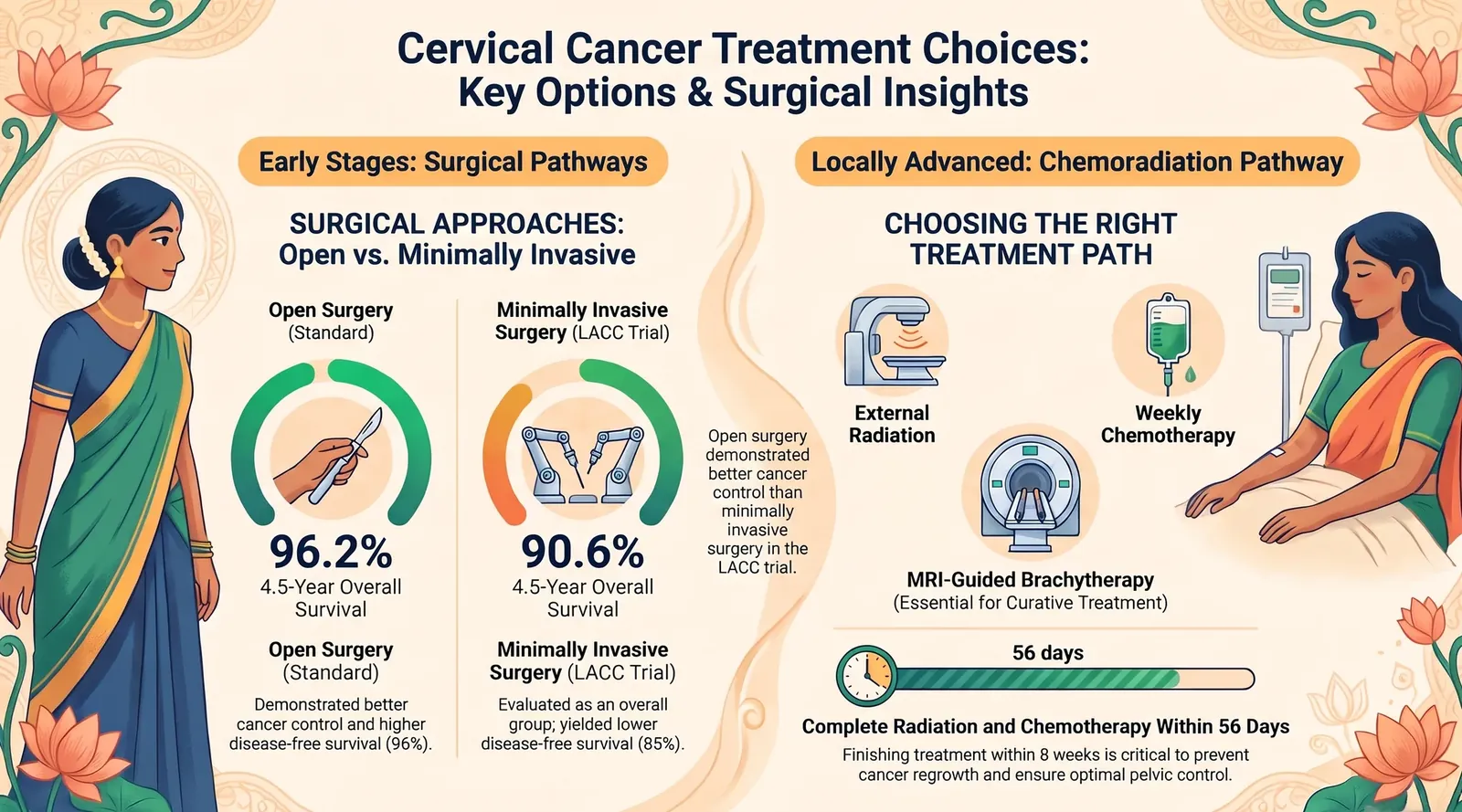
Early-stage cancer: open surgery gave better cancer control than minimally invasive surgery in the LACC trial. Locally advanced cancer: radiation, weekly chemotherapy and brachytherapy, completed within 56 days.
The bottom line
Radiation and brachytherapy are central to the modern treatment of locally advanced cervical cancer. External radiation with weekly chemotherapy and brachytherapy gives an established curative approach, with side effects that can be managed and monitored. Not every cervical cancer needs radiation: selected early-stage cancers can be treated well with surgery.
The best treatment is not necessarily the newest technology, the most extensive surgery, or the option that avoids radiation. It is the treatment supported by evidence for that particular cancer, stage and patient, decided by a multidisciplinary team. This article provides general health information. It does not replace a consultation or a diagnosis.
Frequently Asked Questions
References
- Ramirez PT, Robledo KP, Frumovitz M, et al. LACC Trial: Final Analysis on Overall Survival Comparing Open Versus Minimally Invasive Radical Hysterectomy for Early-Stage Cervical Cancer. J Clin Oncol. 2024;42(23):2741–2746. doi:10.1200/JCO.23.02335.
- Pötter R, Tanderup K, Schmid MP, et al. MRI-guided adaptive brachytherapy in locally advanced cervical cancer (EMBRACE-I): a multicentre prospective cohort study. Lancet Oncol. 2021;22(4):538–547.
- Van Limbergen E, Rijkmans E, Tanderup K, et al. Overall severe morbidity after chemo-radiation therapy and MRI-guided adaptive brachytherapy in locally advanced cervical cancer: results from the EMBRACE-I study. Int J Radiat Oncol Biol Phys. 2023;116(4):807–824.
- Cibula D, Raspollini MR, Planchamp F, et al. ESGO/ESTRO/ESP guidelines for the management of patients with cervical cancer – Update 2023. Int J Gynecol Cancer. 2023;33(5):649–666. doi:10.1136/ijgc-2023-004429.
- Lakhman Y, Veeraraghavan H, Chong J, et al. Staging of Cervical Cancer: A Practical Approach Using MRI and FDG PET. AJR Am J Roentgenol. 2023;221(5):633–648.
- Buonomo B, Massimello F, Ronsini C, et al. Ovarian transposition in patients with cervical cancer prior to pelvic radiotherapy: a systematic review. Int J Gynecol Cancer. 2021;31(3):360–370.
- Laios A, et al. Outcomes of ovarian transposition in cervical cancer; an updated meta-analysis. BMC Womens Health. 2022. doi:10.1186/s12905-022-01887-8.
- Gaillard S, et al. Neoadjuvant Chemotherapy for Newly Diagnosed, Advanced Ovarian Cancer: ASCO Guideline Update. J Clin Oncol. 2025;43(7):868–891. doi:10.1200/JCO-24-02589.
- Concin N, et al. ESGO–ESTRO–ESP guidelines for the management of patients with endometrial carcinoma: update 2025. Lancet Oncol. 2025;26(8):e423–e435. doi:10.1016/S1470-2045(25)00167-6.
- Leitao MM, et al. ROCC/GOG-3043: a randomized controlled trial of robotic versus open surgery for early-stage cervical cancer (trial design). Int J Gynecol Cancer. 2025;35(7):101760. Trial registration NCT04831580.
- Government of India, Press Information Bureau. National HPV vaccination drive, 28 February 2026. https://static.pib.gov.in/WriteReadData/specificdocs/documents/2026/feb/doc2026228807201.pdf
- American Brachytherapy Society recommendation on overall treatment time of 56 days for chemoradiation, as cited in: Zaki MA, et al. Cureus. 2016. HDR fractionation frequencies: GCIG international brachytherapy practice patterns survey. Int J Radiat Oncol Biol Phys. 2014;82(1).
Related Reading

Facing a cervical cancer treatment decision?
Dr. Dipanwita Banerjee offers consultations at CNCI Kolkata for gynaecological cancers, including review of scans, biopsy reports and treatment options.