HPV positive: what the result means and what to do next.
An HPV-positive report often causes fear. Many women immediately worry about cervical cancer, surgery, or whether a husband or partner has been unfaithful. Others ask whether vaccination still makes sense after marriage, or after an infection has already been found.
The reassuring fact is that most HPV infections are controlled by the immune system and do not cause cancer. The concern is a high-risk HPV type that persists for years, because that can lead to precancerous cervical changes. Those changes can be found and treated, which is why follow-up matters.
This guide is general health information for patients and caregivers in India. It is not a diagnosis. Your next step depends on your age, your full report, your screening history and any previous treatment.
A positive HPV test is not a cancer diagnosis. HPV 16 or HPV 18 usually needs colposcopy even if the Pap smear is normal, and the vaccine protects against types you have not yet acquired, but it does not clear an existing infection.
The Short Version
- A positive HPV test is not a cancer diagnosis. Most infections are cleared by the immune system.
- HPV 16 or HPV 18 usually needs colposcopy even if the Pap smear is normal.
- A positive result does not prove when or from whom HPV was acquired, so it is not proof of infidelity.
- HPV vaccination protects against types not yet acquired. It does not treat an existing infection, and vaccinated women still need screening.
- Since 28 February 2026, India has a free government HPV vaccination programme for eligible girls aged 14. It does not cover adults or boys.
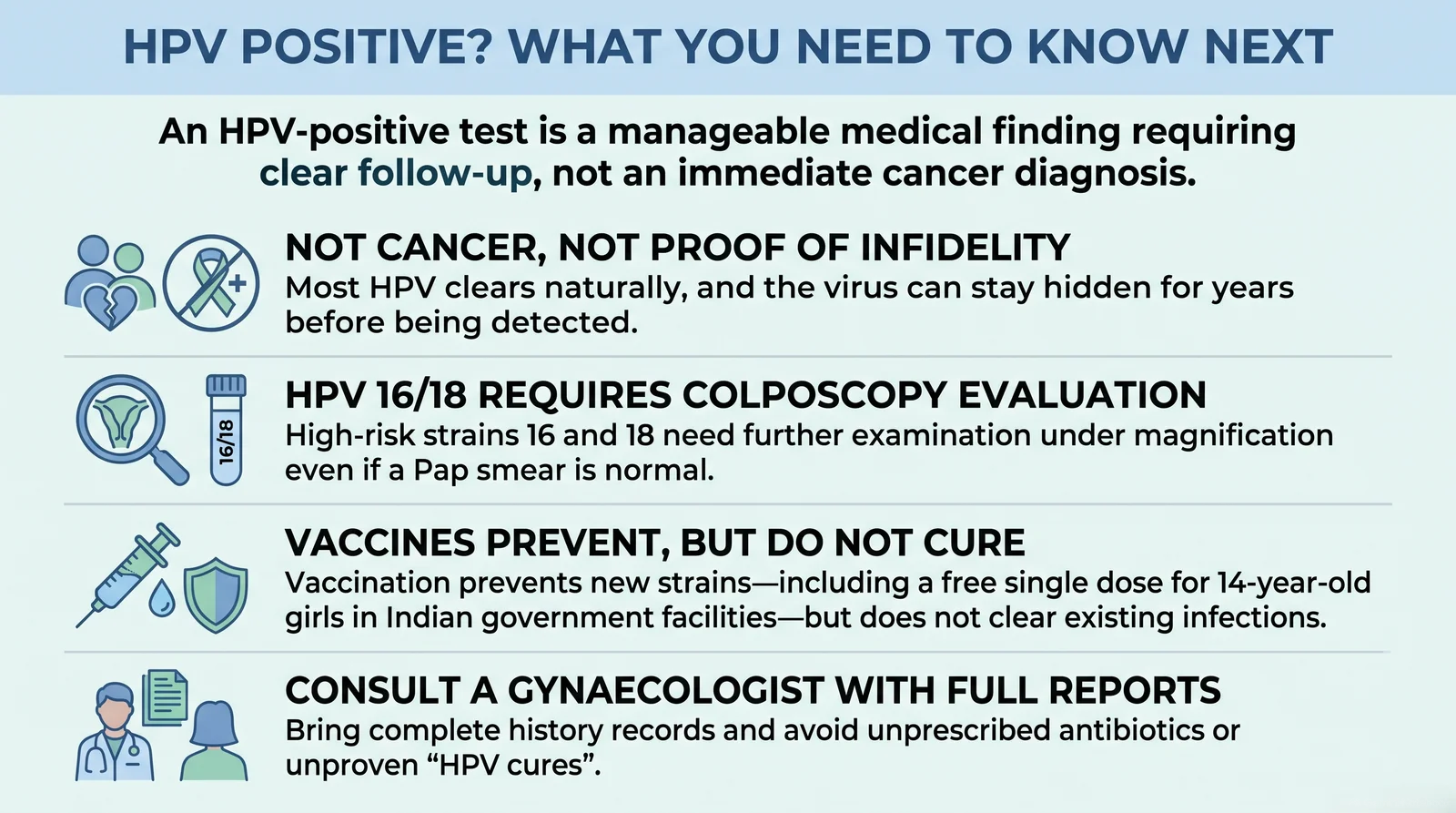
A positive HPV test needs clear follow-up, not an immediate cancer diagnosis.
What is HPV?
HPV stands for human papillomavirus, a group of more than 200 related viruses. They infect the skin and moist surfaces, including the genital area, anus, mouth and throat. Almost all sexually active people will be infected at some point in their lives, usually without any symptoms.[1]
HPV types are grouped by the disease they can cause:
- Low-risk types (for example, types 6 and 11) can cause genital warts.
- High-risk types can cause cervical precancer and cancer if they persist. HPV 16 and HPV 18 are the most important of these.
Does HPV Always Cause Cancer?
No. Most infections never cause disease. In about 90% of people the immune system clears HPV on its own, usually within a year or two.[1]
The risk comes from persistent infection with a high-risk type. Over time this can cause precancerous changes in cervical cells. Screening finds these changes early, and treating precancer prevents most cervical cancers.[1]
Does an HPV-Positive Result Mean I Have Cervical Cancer?
No. An HPV test detects the virus or its genetic material. It does not diagnose cancer. Your report may show one of these situations:
- High-risk HPV positive, normal Pap smear: The virus is present, but the cells sampled look normal.
- High-risk HPV positive, abnormal Pap smear: Further assessment is needed to grade any cell changes.
- HPV 16 or 18 positive: These types need evaluation even if the Pap smear is normal.
- Biopsy showing CIN: Cervical intraepithelial neoplasia describes precancerous change of varying grades. It is not invasive cancer.
A normal Pap smear is reassuring about the cells that were sampled. It does not cancel a positive high-risk HPV result, so do not ignore the report because the Pap smear is normal.
What are HPV 16 and HPV 18?
HPV 16 and HPV 18 are the two high-risk types most strongly linked to cervical cancer. The Government of India's launch announcement for the 2026 vaccination programme describes them as responsible for more than 80% of cervical cancer cases in India.[2]
HPV 16 is most strongly associated with squamous precancer and cancer. HPV 18 has a notable association with glandular (adenocarcinoma) cervical cancer, which can be harder to detect on a Pap smear.
Is HPV 16 More Dangerous Than HPV 18?
HPV 16 is generally considered the type most strongly linked to precancer. However, HPV 18 should not be treated as harmless. Neither type alone tells you a person's prognosis. The meaning of the result depends on the full assessment, including cytology, examination, any biopsy and screening history.
What Happens If HPV 16 Is Positive?
International risk-based guidance recommends colposcopy even when the Pap smear is normal, and the CDC's clinical guidance says the same for HPV 16 or 18 positive results.[3] Your clinician will apply the relevant local protocol and your clinical history. Colposcopy is an examination of the cervix under magnification. A biopsy is taken only if an abnormal area is seen. You can read more about colposcopy in Kolkata.
A positive HPV 16 result does not mean you need surgery, a hysterectomy or cancer treatment.
What Happens If HPV 18 Is Positive?
HPV 18 also warrants colposcopy, even with a normal Pap smear. Because HPV 18 is linked to glandular changes, your gynaecologist may also assess the endocervical canal. A positive HPV 18 result is a reason for timely follow-up, not a sign that cancer is already present.[3]
Can HPV-Positive Women Still Have Normal Pap Smears?
Yes. HPV testing and Pap cytology look for different things. The HPV test detects the virus. The Pap smear looks at cell shape. A woman can have a high-risk HPV infection while the cells sampled look normal. This is one reason a normal Pap smear alone is not enough after a positive HPV test.
Can HPV Remain Dormant for Years?
Yes. HPV can become undetectable and then be detected again, sometimes years later. Routine testing cannot reliably tell apart a new infection from an old one that was below the detection limit of an earlier test.[1]
Can HPV Come Back After Becoming Negative?
Yes. A later positive result is possible after a negative one. It does not automatically mean a new infection. A negative test is reassuring, but it does not prove the virus has been eliminated from every site in the body.
Can HPV Disappear on Its Own?
Usually, yes. In most people the immune system controls the infection without treatment, and the test later becomes negative. There is currently no medicine that reliably eradicates HPV itself. Treatment targets the problems HPV can cause, such as genital warts or precancerous cervical lesions.
Be cautious about supplements, unproven remedies or repeated courses of medicines advertised as HPV cures. Follow the screening and follow-up plan your doctor recommends.
Can HPV Be Transmitted After Many Years?
Possibly, but a positive test years after exposure does not show when the virus was acquired. Because HPV can be silent for years, the date of a positive test says little about the date of infection.
How Long Does HPV Take to Cause Cancer?
For cervical cancer, the WHO notes that it usually takes 15 to 20 years after HPV infection to develop.[1] This is a typical timeline, not a fixed schedule for any individual. Most infections are controlled long before any precancer develops. For this reason, a positive result should be followed through a proper pathway. It should be neither ignored nor treated as an emergency cancer diagnosis.
Does an HPV-Positive Result Mean My Husband or Wife Was Unfaithful?
No. An HPV-positive result is not evidence of infidelity. HPV can remain undetected for years, so an infection may have been acquired long before, possibly during a long-standing relationship. Medical tests cannot reliably establish when HPV was acquired or which partner passed it on.
Can I Get HPV From My Husband or Wife?
Yes. HPV spreads through intimate skin-to-skin genital contact and is common in couples. Partners can carry and share HPV without symptoms, which is one reason it is so hard to pinpoint the source.[1]
Can HPV Be Transmitted Without Intercourse?
Yes. Genital skin-to-skin contact can spread HPV without penetrative sex, and oral sexual contact can also transmit some types.[1] Condoms reduce the risk but do not fully prevent it, because they do not cover all genital skin. HPV is not usually spread through everyday contact such as sharing meals, hugging or using toilets.
Does My Partner Need Testing or Treatment?
There is no routine HPV test for men without symptoms. A partner should see a doctor if he has genital warts, unusual lesions or symptoms. An HPV diagnosis in one partner does not mean both need treatment, because there is no established treatment that clears asymptomatic infection. Discuss HPV as a shared health issue rather than a question of blame.
Can HPV Cause Ovarian, Uterine, Vaginal, Vulval or Other Cancers?
HPV is linked to some cancers beyond the cervix. According to the WHO, HPV-associated cancers include cervical cancer (the most common), and also cancers of the vulva, vagina, mouth and throat, penis and anus.[1]
| Cancer | Link with HPV |
|---|---|
| Cervical | Persistent high-risk HPV is the established cause of nearly all cases. |
| Vaginal | Some cases are linked to high-risk HPV. |
| Vulval | Some cases, particularly certain squamous cell cancers, are linked to HPV. Others have different causes. |
| Uterine (endometrial) | HPV is not an established cause. |
| Ovarian | HPV is not an established cause. |
An HPV-positive cervical test therefore does not mean you have ovarian or uterine cancer. Symptoms such as persistent abdominal swelling, a pelvic mass, bleeding after menopause or unexplained bleeding still need evaluation whatever your HPV status. You can read about gynaecological cancers and their warning signs.
What Should I Do If My HPV Test Is Positive?
- Get the full report. The words "HPV positive" are not enough. Check whether it states high-risk or low-risk, whether HPV 16 or 18 is named, and whether Pap or liquid-based cytology results are included.
- Collect your history. Bring previous Pap, HPV, colposcopy and biopsy reports, and note any treatment you have had.
- See a gynaecologist experienced in cervical screening and colposcopy. Our guide on which doctor to see for gynaecological cancer in Kolkata explains how to choose.
Tell your doctor if you are pregnant, immunocompromised, have had cervical precancer, or have symptoms. These can change the timing and approach. Do not take antibiotics or antifungal tablets just because HPV is positive. They do not treat HPV.
How Often Should I Repeat the HPV Test?
There is no single interval for everyone. The CDC's clinical guidance gives the following approach for typical situations. Your gynaecologist will apply the protocol that fits your results and history.[3]
| Finding | Usual next step |
|---|---|
| HPV 16 or 18 positive | Colposcopy, even if the Pap smear is normal. |
| Other high-risk HPV positive, normal cytology, no prior positive HPV result | Repeat HPV testing (with or without Pap) in one year. |
| Two consecutive HPV-positive tests | Colposcopy. |
| HPV positive with abnormal cytology | Colposcopy or further assessment, depending on the grade. |
| After treatment for cervical precancer | Follow your specialist's post-treatment schedule. |
Do not wait a year if HPV 16 or 18 is positive, if cytology is significantly abnormal, or if your doctor has advised earlier review. Do not repeat the test every few weeks hoping for a negative result either, because intervals are chosen so the result can be interpreted properly.
Cervical Screening in India
India's national NCD screening programme for women aged 30 and above currently uses visual inspection with acetic acid (VIA).[4] That is a screening programme question. Once you have a positive HPV result, the management steps in this article apply to your individual care, whatever screening test was used. For the screening schedule itself, read our article on cervical cancer screening and HPV vaccination in India.
Who Should Take the HPV Vaccine?
HPV vaccination protects against HPV types a person has not yet been exposed to. It works best before sexual exposure, but it is not limited to unmarried girls. Our article on the journey of the HPV vaccine in India covers the history and the national programme in more detail.
At What Age Should the HPV Vaccine Be Given?
Three things are often confused, so they are separated here.
- Clinical recommendation: The IAP's 2026 immunisation guidance recommends a single dose for immunocompetent girls aged 9 up to their 15th birthday. Boys in the same age group receive two doses.[5] The WHO also recommends HPV vaccination for girls aged 9 to 14, before they become sexually active.[1]
- Product licensing: Approved ages depend on the brand. According to the IAP guidance, Gardasil 4 is licensed up to age 45, and Gardasil 9 is approved for females aged 9 to 26 and boys aged 9 to 14.[5] Check the product label and your clinic's advice.
- Government programme: Free, single-dose Gardasil 4 for eligible 14-year-old girls, described below. This is a programme rule, not a general clinical rule for everyone.
Can Adults Take the HPV Vaccine?
Some adults can benefit, but there is no single schedule that applies to every adult. The IAP guidance recommends three doses (0, 2 and 6 months) for people older than 15 and for immunocompromised people of any age.[5] Whether vaccination is appropriate depends on age, past exposure, the approved age range of the product and the likelihood of future exposure. Discuss the product and schedule with a qualified vaccinating clinician.
Can Married Women Take the HPV Vaccine?
Marriage is not a contraindication. An unvaccinated married woman may still benefit, especially if she has not been exposed to all the vaccine types. The likely benefit usually falls with age and prior exposure, and eligibility depends on the product and her age.
Can Women Who Have Already Had Sex Take It?
Yes, if they meet the age and medical criteria for the product. Previous sexual activity does not mean every vaccine type has been acquired. The vaccine does not treat an infection already present or reverse existing cell changes.
Can Someone With HPV Take the Vaccine?
A positive HPV test does not automatically rule out vaccination. The vaccine may protect against vaccine types that the person has not yet acquired, but it will not clear the current infection. HPV testing is not needed just to decide whether to vaccinate.
Can Someone Who Has Had CIN Take the Vaccine?
Vaccination may be considered after a diagnosis or treatment of CIN, but it does not replace treatment or follow-up. The evidence on whether it reduces recurrence is still developing, so discuss timing and expected benefit with your gynaecologist.
Can Boys Take the HPV Vaccine?
Yes. Vaccination can protect boys and men against vaccine types, which helps prevent genital warts and some HPV-related cancers, including anal and some oropharyngeal and penile cancers.[1] The IAP recommends two doses for boys aged 9 to 15, given at 0 and 6 months.[5] The 2026 government programme is for girls, not boys.
How Many Doses of the HPV Vaccine Are Needed?
The number of doses depends on the product, age at first dose and immune status. Current IAP guidance is summarised below.[5]
| Who | Schedule (IAP 2026 guidance) |
|---|---|
| Immunocompetent girls aged 9 up to their 15th birthday | One dose |
| Boys aged 9 up to their 15th birthday | Two doses, at 0 and 6 months (at least 5 months apart) |
| People older than 15, and immunocompromised people of any age | Three doses, at 0, 2 and 6 months |
| Eligible girls in the 2026 government programme | One free dose of Gardasil 4 |
Private providers may use different schedules. Ask the clinic which schedule it follows and why. If a dose is delayed, ask the vaccinating clinician how to continue. Do not restart the whole course solely because of a delay. Keep a record of the vaccine name, batch if available, date and dose number.
Which HPV Vaccines Are Available in India?
- Bivalent: covers HPV 16 and 18 only.
- Quadrivalent (Gardasil 4; Cervavac): covers HPV 6, 11, 16 and 18.
- Nonavalent (Gardasil 9): covers HPV 6, 11, 16, 18, 31, 33, 45, 52 and 58.
The government programme uses Gardasil 4. Private clinics may offer Gardasil 9 or other products. Broader coverage does not mean full protection, and product availability and approval can change, so confirm the exact product and its approved age range before booking.
Is the HPV Vaccine Safe?
The WHO states that HPV vaccines contain no live virus and no viral DNA, so they cannot cause HPV infection or HPV-related cancer.[1] Like all vaccines, they can cause side effects, which are usually mild.
What Are the Side Effects?
- Pain, redness or swelling where the injection was given.
- Headache, tiredness, mild fever, nausea, dizziness or muscle ache.
- Fainting around the time of the injection, especially in teenagers. Sit or lie down during vaccination, and stay for about 15 minutes afterwards.
Severe allergic reactions are rare but need urgent medical care. Tell the clinic about any previous severe reaction to an HPV vaccine or any of its ingredients, including yeast.
Can I Be Vaccinated During Pregnancy?
No. HPV vaccination is not recommended during pregnancy. If pregnancy happens during a course, the remaining doses are usually deferred until after delivery. An accidental dose during pregnancy is not, by itself, a reason for alarm, but tell your doctor.
Does HPV Vaccination Prevent Cervical Cancer Completely?
No. HPV vaccination greatly reduces infection and disease from the types it covers, and its benefit is greatest before exposure. It does not treat existing infection or CIN, it does not cover every cancer-causing HPV type, and it cannot guarantee that cervical cancer will never develop.[1]
Do Vaccinated Women Still Need Cervical Screening?
Yes. Vaccinated women should continue cervical screening at the recommended age and interval. Vaccination lowers risk; it does not remove it.
Is HPV Vaccination Free Through Government Hospitals in West Bengal?
Partly, and only for eligible girls.
- National programme: Launched on 28 February 2026, it offers a free single dose of quadrivalent Gardasil to girls aged 14 at government facilities, with a target of about 1.15 crore girls a year. Vaccination is voluntary and requires parental or guardian consent. Girls who turn 15 within 90 days of the launch were also eligible during the initial three-month campaign. Girls who have already received any HPV vaccine are excluded.[2]
- West Bengal: The state launched its drive on 30 May 2026, targeting about 7.65 lakh girls who have completed 14 years but not yet turned 15. The state has designated 881 government facilities, including medical colleges, district and sub-divisional hospitals, state general hospitals and block primary health centres.[6]
The free programme does not cover adult women, married women outside the eligible age group, or boys. Confirm eligibility, session dates and stock with your local government facility before travelling.
Where Can I Get HPV Vaccination in Kolkata?
- Government facilities: Contact a nearby government medical college, district or sub-divisional hospital, or block primary health centre about the current programme and any adult services.
- Private hospitals: Ask the vaccination, preventive health or gynaecology department whether the product is in stock and whether they vaccinate adults.
- Private vaccination providers: Several clinics in Kolkata list HPV vaccines. Confirm the exact product, approved age range, total price, cold-chain handling and follow-up doses before booking.
When booking, ask:
- Which vaccine brand is being given, and is it approved for my age?
- What is the total cost, including administration and any follow-up?
- How many doses do I need, and at what intervals?
- How is the cold chain maintained?
- Can the remaining doses be given at the same clinic?
If you already have a positive HPV test or a history of CIN, tell the clinic and your gynaecologist. Vaccination may still be appropriate, but your screening and treatment needs must be reviewed separately.
Frequently Asked Questions
When Should You See a Doctor Without Waiting?
Do not wait for your next routine appointment if you have:
- Bleeding after sexual intercourse.
- Bleeding after menopause.
- Unusual or persistent vaginal bleeding or discharge.
- A genital lesion or ulcer that does not heal.
- Persistent pelvic pain or other symptoms that worry you.
These symptoms often have causes other than cancer, but they need examination rather than attribution to HPV without assessment. For a fuller list, see our guide to gynaecological warning signs.
The Key Message
An HPV-positive result is a reason to understand your report and follow the right pathway. It is not a reason to assume you have cancer, and it is not proof of infidelity.
- HPV positive does not mean cervical cancer.
- HPV 16 or 18 usually needs colposcopy even if the Pap smear is normal.
- HPV vaccination prevents new infections, including for some adults and married women, but it does not treat existing infection and does not replace screening.
Take your complete report and previous screening or biopsy records to a qualified gynaecologist. Your next step should be based on your results and history.
References
- World Health Organization. Human papillomavirus and cancer: fact sheet. who.int. Accessed 29 October 2026.
- Government of India. Press Information Bureau: nationwide HPV vaccination programme launch, 28 February 2026. PDF.
- US Centers for Disease Control and Prevention. STI Treatment Guidelines, Table 2: Cervical cancer screening results and management. cdc.gov. Accessed 29 October 2026.
- Government of India. Lok Sabha reply on cervical cancer screening under the NCD programme. PDF.
- Shastri DD, Dhir SK, Rajsekhar B, et al. Indian Academy of Pediatrics Advisory Committee on Vaccines and Immunization Practices. Recommended Immunization Schedule (2025) and Update on Immunization for Children Aged 0 Through 18 Years. Indian Pediatrics. 2026;63:311–324. PDF.
- PTI. West Bengal HPV vaccination launch, 30 May 2026. ThePrint. theprint.in.
Related Reading

Have an HPV-positive report to review?
Dr. Dipanwita Banerjee offers consultations at CNCI Kolkata for colposcopy, cervical screening, HPV result interpretation and HPV vaccination advice.